A Girl Part Named Doug
It may be a small point, but I for one am a little tired of so many pieces of female anatomy being named after men. I’m not even talking about the fallopian tubes, which have been recently renamed as uterine tubes thus taking the name out of the equation. I actually kind of liked that one. But really, the pouch of Douglas? And it’s other name is so clear, the rectouterine pouch. It lies between the rectum and the uterus, so why wouldn’t we want to call it the rectouterine pouch? I never met this Dr. James Douglas and I’m a little uncomfortable giving his memory that kind of real estate in my body. But apparently the nomenclature of the pouch of Douglas is the more common usage. It’s like when I learned that the term G-Spot was named after Dr. Ernst Grafenberg. At least when Masters and Johnson first wrote about the clitoris, they had the good sense not to name it after themselves. I mean, its gotta be a special kind of ego that studies the opposite sex and pushes to get their name in there. Oh, who am I kidding, what kind of scientist goes into studying the opposite sex who *wouldn’t* want their name in there?! Just the same, it does sound awfully silly.

A touch of silly
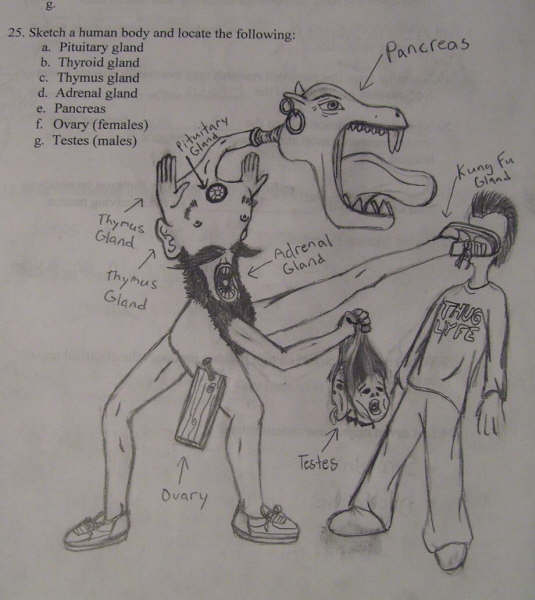
Lately I’ve been trying to play catch up with my classes, after missing some days with a cold. So it seems like time to pull out this old piece of silliness. I have no idea who originally drew this. It was sent to me by a friend who knew I was studying anatomy.
Yeah.
A Sculptor Visits
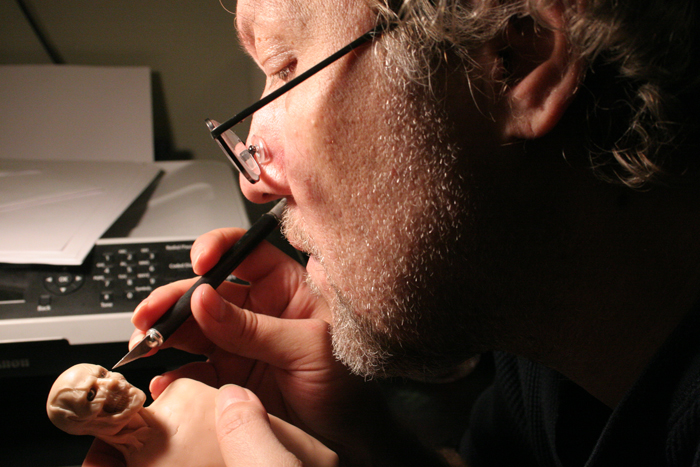
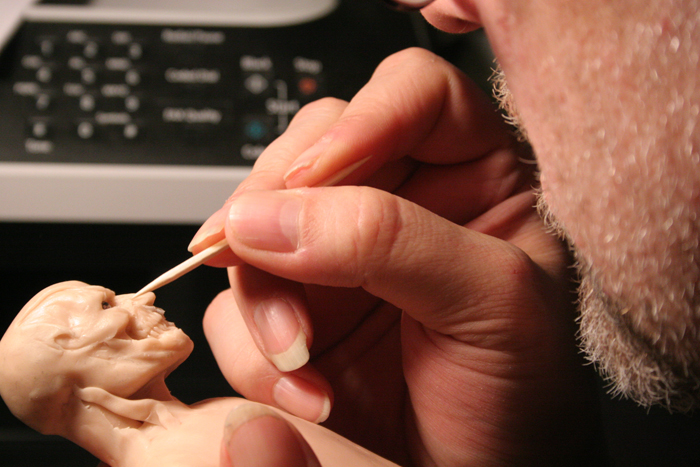
I’ve been enjoying a visit lately from sculptor Ian Coulter. You might say that he was one of my primary influences in becoming so focused on anatomy in art. Lately he’s been putting together a new zombie kit, which makes for some interesting conversations between us when I’m coming home from Gross Anatomy, and he’s taking in my stories with wheels turning toward new sculpting ideas. Personally, I’m starting to want to make my own zombies, and study the various organs by exposing them in gore fashion! I do love horror, and it is the season!
The Thorax
This week, our gross anatomy class has been spending a little time checking out the thorax. So far we’ve mostly remained above the diaphragm so it’s mostly heart and lungs in there.

There is something very cool about holding a human heart in your hands. It really is an impressive piece of organic machinery. I cut through the left ventricle to open it up, and couldn’t believe how thick the walls were. The walls of the left side of the heart are always thicker than the right. That’s because it has to pump blood out to the whole body through the aorta, whereas the right side only has to pump as far as the lungs. And the muscles inside look right out of an alien landscape.
Everything in there is also so compact, the way that the heart and the lungs and all the vessels between fit together. When you first remove the lungs, they have indentations for the heart all the superior heart vessels. And the heart largely takes it’s shape from having been wrapped in the lungs and sat on the diaphragm for all that time. The esophagus, trachea, and thoracic aorta are all centered in the space offered between the lungs. The sympathetic chain hides out between the inner and innermost intercostal muscles and manages to cover so much space without ever getting in the way of anything else.
All in all, it’s a cool little area to see.
Microscopic Photography
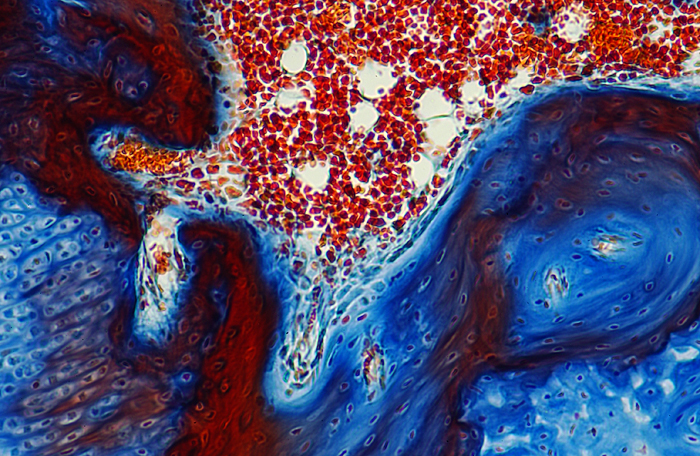
Today I got to take pictures with a microscope. I’d been given the overview of how it all worked once before, but today was the first time I ever really got to play with one. Everything I shot was off of the same slide. I’m told it was a mouse cochlea, but it looked like art to me.
This one was my favorite image of the bunch…
The rest can be seen here…
http://snapshotgenius.com/gallery/rodentcochlea
These were fun to take!
note: further conversation with the histologist who stained the slides in the first place, Dr. TK Bhattacharyya, revealed this to actually be the cochlea of a guinea pig. Live and learn.
Legs Legs Legs!

Ah yes, so I’ve been studying legs tonight. And I did a little sketching to help me get it all straight.
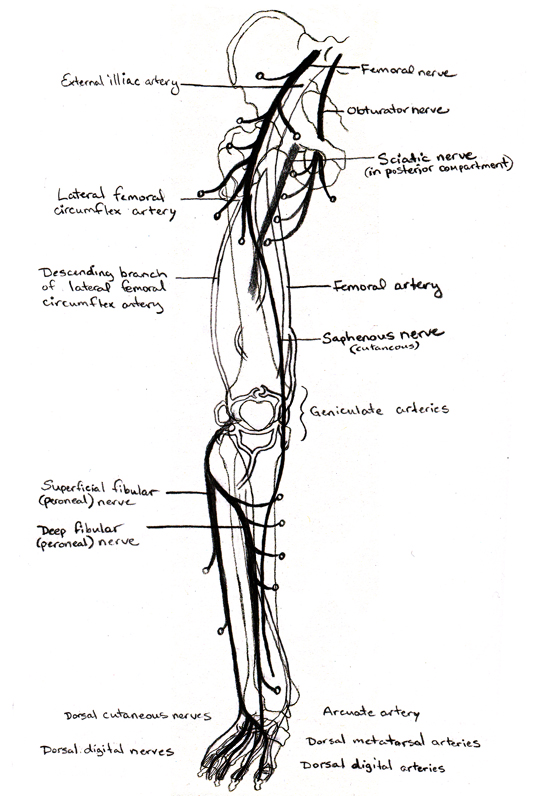 All together, I believe this is the gist of the situation.
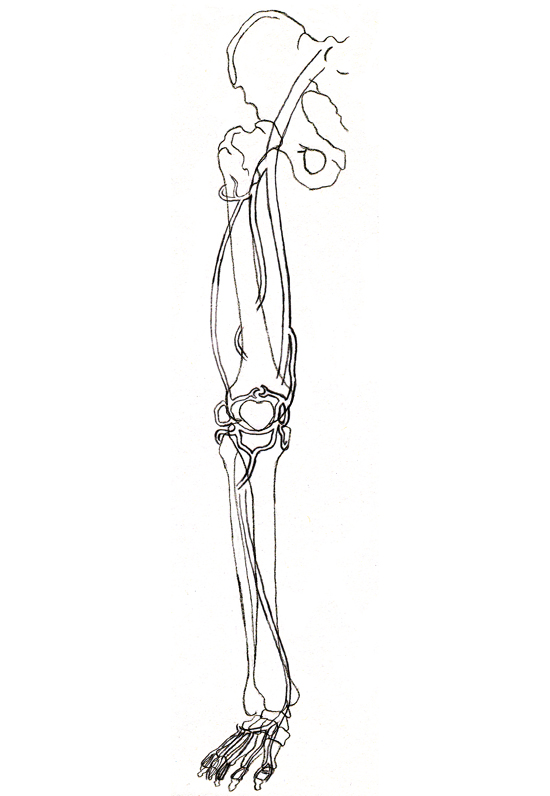 Here is the same thing with just the arteries.
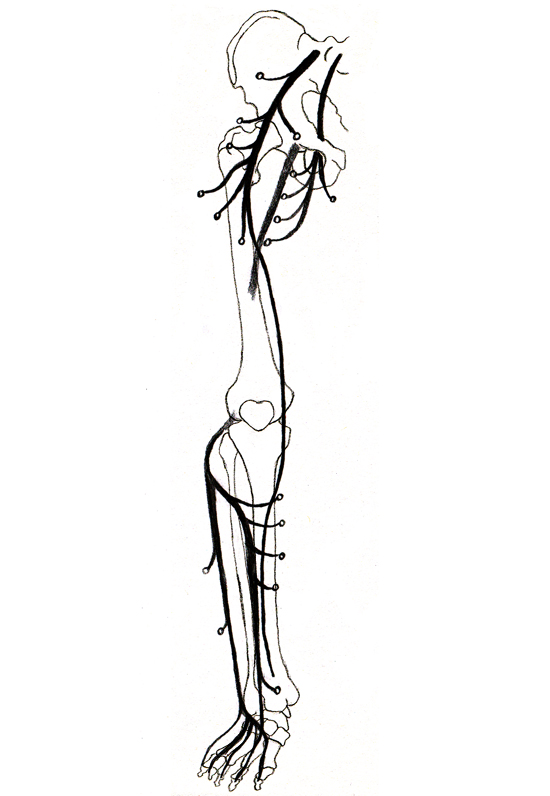 And here it is again with just the nerves. Those dots at the end represent the various muscles being innervated. They include iliacus, sartorius, recuts femoris, and your three vastus muscles off the femoral nerve. Then pectineus, obturator externus, gracilis, adductor magnus, adductor brevis, and adductor longus off the obturator nerve. And then the fibularis longus and fibularis brevis off the superficial fibular nerve, and extensor digitorum longus, tibialis anterior, extensor hallucis longus, fibularis tertius, and extensor digitorum brevis off the deep fibular nerve.
A few neurovascular relationships worth noting are that the femoral triangle contains the femoral nerve, artery, and vein, in that order going laterally to medially. The great saphenous vein (not pictured here) accompanies the saphenous nerve. And in the back (and thus not visible here) the small saphenous vein accompanies the sural nerve.
The above drawings are from an anterior view, with some reference as to what’s going on in back so long as it doesn’t cross behind bone. Do not use these for reference as to whether the nerve or artery is superficial or deep. Both systems are fully drawn without regard for empty spots where one crosses in front of the other. And lastly, I really wish I could give the photographer credit for the first image up there, but alas I cannot make out what the watermark says. But thank you G.S. for such a beautiful image, and good reference for leg and foot surface anatomy!
Anatomy Socks
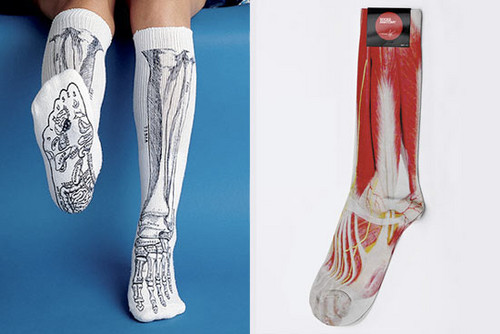
Gotta love ’em.
I’ve got a pair on just like the ones on the left today, and this morning I was able to reference them while reading about the pathways of the various tendons in the leg, as well as the arteries and nerves. The ones on the right look pretty cool too, for learning the muscles. I believe that’s the superficial fibular nerve that you can see there popping out from between the muscles there toward the dorsum of the foot. Pretty neat, pretty neat!
hands

There are truly a great many things which influence the hands.
There are 9 tendons traveling through the carpal tunnel from muscles in the forearm to allow flexion and extension of the proximal and distal interphalangeal joints. There are short intrinsic muscles between the metacarpals which allow for abduction and aduction of the metacarpals. There are 4 lumbricals which allow for flexion at the metacarpal phalangeal joint, as well as some hyperextension when the hand is in an already extended position. And then specialty muscles for the thumb and pinky finger that allow for flexion, extension, and opposition. Both the ulnar and median nerves travel into the hand, as well as some superficial branches of the radial nerve. Ulnar and radial arteries travel in as well and create arches that put off smaller arteries into the fingers.
We have all those little carpal bones, eight of them. Scaphoid, being the one to connect with the ulna. Scaphoid is also the most commonly broken. Capitate, being the largest, and also so prominent by it’s central positioning. Hammate and pisiform on the ulnar side of the hand working with trapezium to create the carpal tunnel and allow passage for all those tendons along with the median nerve.
Yup, there’s a lot happening in there. It all seems like quite an arrangement.
Be good to your hands. They are complicated pieces of equipment.
animation – the possibilities
Last week, I posted my very first animation. It was created using 3dsMax, and then I added some sound in Final Cut Pro afterwards. It was pretty cool figuring out how to make all those little objects move around and interact with one another.
I’ve been thinking a lot about animation lately. Just last week I spoke with a surgeon who is interested in creating patient education animations to give to his patients prior to surgery. This has me thinking a lot about what is possible there, and what is appropriate. There is a website, Understand.com that specializes in doing this kind of thing. Some of their pieces I like better than others. It’s nice having some time to think about what I feel is important to a patient education video, and to talk to previous patients of various procedures about the kinds of things that they understood going into surgery, and what they wished they’d understood afterwards. If anyone reading has any thoughts and/or personal experiences to this end, I ask you to please comment with your thoughts.
Drawing Science
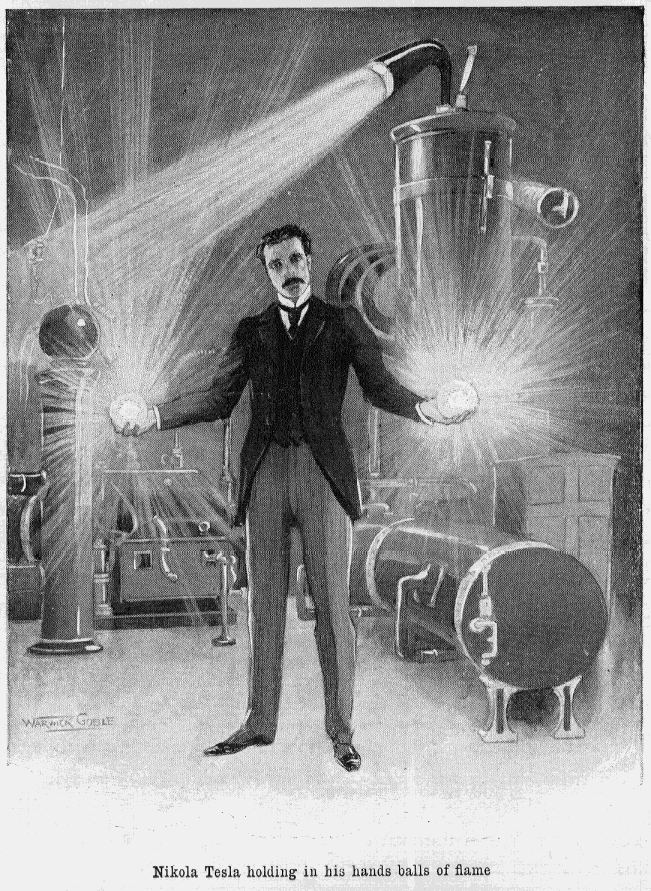
I was just thinking a bit about how one conveys science in art, and I thought of this picture of Tesla. I saved it a long time ago. I think I originally found it in a Google image search. I love how it not only shows us a picture of Tesla, but also his work, and manages to be this interesting energetic drawing all at the same time. I suppose it’s very editorial in nature.
Unfortunately I have no idea who the artist was. If someone reading does, please chime in with that information, as I would be interested to see what other work this artist has done.