Animation Finished!
This week I finally finished the 3D animation that I have been working on this semester. It’s subject is the sliding filament theory of muscle contraction and I believe that I have managed to put together something clear.
I find that I still struggle in places with 3DsMax, but learning After Effects and coming back to working in Final Cut Pro again was a lot of fun. Our class on the whole created some really great work.
TK’s Lab
A few months ago, I posted some microscopic photography work I was learning to do. About a month ago I was handed a camera and asked to get some footage of the man who created those slides in the first place. His name is TK, and you can view the resulting video here if you are interested.
Because it’s that time of year again…
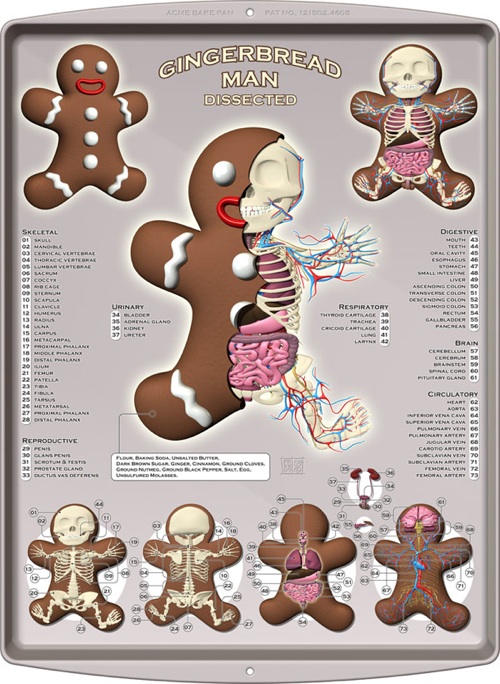
Yes, it’s the work of Jason Freeny.
Mmmmm, gingerbread cookies 🙂
just a quick bit of advice…
If you ever find yourself in a difficult anatomy class, find the artists in your class! Artists studying anatomy can keep the best notes sometimes!
Science Photo Library
So I was tracking down the image below, and discovered a new resource for good scientific images.
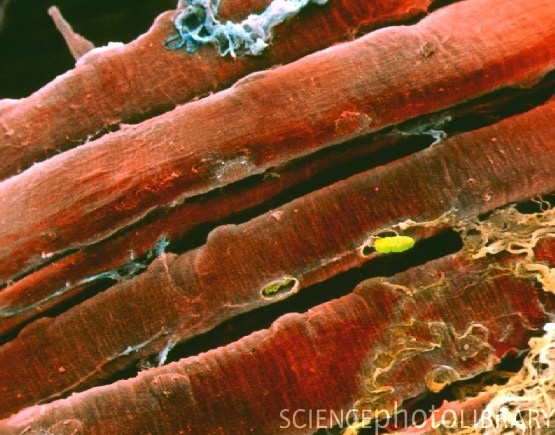
The website it came from is http://www.sciencephoto.com/. The image itself is credited to Professors P.M. Motta, P.M. Andrews, K.R. Porter “& J. Vial. Apparently, this is what one can do with an electron micgrograph and some skill with color. This is actually the shot that first made me understand that there are two kinds of striation in skeletal muscle, the actual fibers, and then the banding created by the myofilaments arranged inside. Take a close look!
Animation Woes
I’m going to try something a little bit differently here today. I’m going to write about a problem that I have been encountering lately using 3DsMax. Maybe, just maybe, someone reading here will have some insight.
So, I’ve been taking a class lately on medical 3D animation. For my topic, I chose to delve further into the sliding filament theory of muscle contraction. I was having a little trouble getting the myosin necks to move appropriately and the advice to that was to use bones. Having never done that before, it’s been a madhouse of tutorials and learning all that I can about using them. It took a little while but I finally got them to work. Now, being an individual neck of the myosin, it made sense to instance the little heads and neck cluster across the myofilament, and then instance the myofilament itself to build the 3D reality of how myosin and actin myofilaments interact.
Sounds great right? Well I thought so. And I sure was excited when I finally got the bones set up with inverse kinematics, and the myosin heads and neck shape skinning it without distortion. I made a bunch of instances, and the whole row of them would do a little chorus line dance when I pulled the strings on the lead myosin head and neck group. The next part is where it starts to get wonky.
So I took my instances and carefully placed them all along the body of the myofilament. I found that removing the kinematics and bones from the instances allowed me more flexability in placement and still kept the movements I was after. Everything looked great. You might even say it was fantastic. But after several rebuilds of my scene, I have come to learn that this is the exact point where things go haywire. I have been saving the project all along, but it seems that I cannot open any of the saved versions after this point. Well, I *can* open them, but it’s never the way I’ve left it.
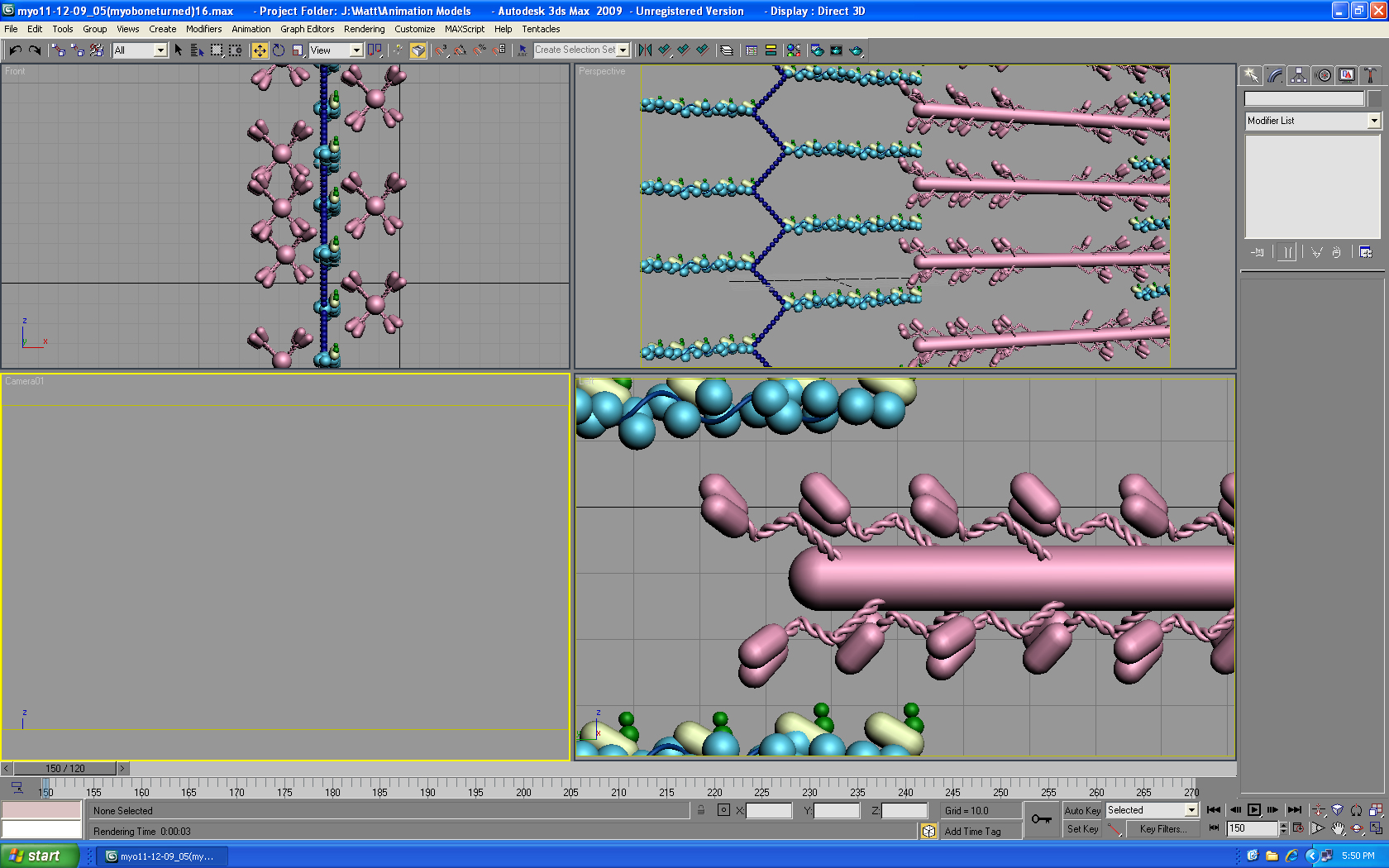
So for instance, this is a screen shot of my happy little project *prior* to turning anything off, or shutting down…
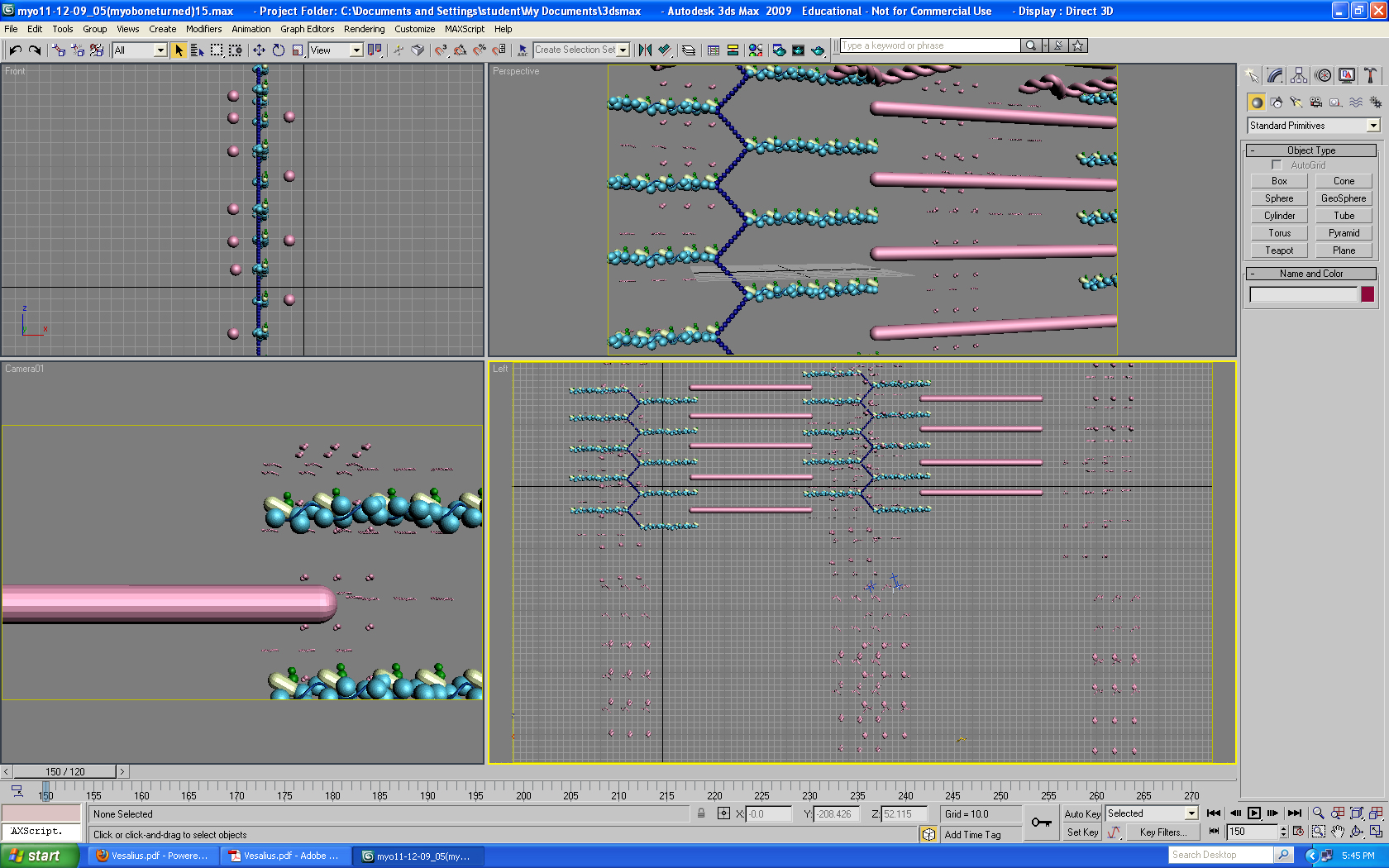
Then this is what happens when I open the same project later (I believe there are actually a few minutes of work between these two screen shots, but not much). The myosin heads and necks fly off, out into my scene. As you can see, I’m hitting a glitch…
So I spoke with a friend about it, who has done some work in games. He had me convinced that the problem I was hitting just had to be the mirror modifier that I’d used to make the intertwined necks of the myosin heads. So I deleted and rebuilt the myosin yet again, only to learn that the mirror modifier is not in fact the problem, and I am still unable to save and reopen the project.
My modifier stack is clean as a whistle, just the object used as skin and the skin modifier. My bones on their own right are great. My inverse kinematics are just what I wanted. This happens whether objects are grouped or ungrouped. The actin myofilaments remain unaffected. So what is going on with my myosin? I am at a complete loss for this one.
If any of you reading have ever come across this before, I would love to hear about it, and particularly what you did to either fix it or get around it.
Cranial Nerves
Lately I’ve been playing around a little with the idea of mnemonic imagery. Here are some little sketches laying out the 12 cranial nerves…
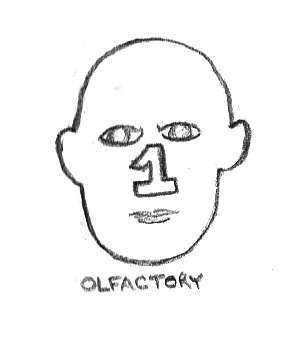
The first cranial nerve is the olfactory nerve. It’s easy to remember. We have one nose. It’s the first feature on a face. The olfactory bulb sits right over the cribiform plate where olfactory nerve branches reach down into the top of the nose to pick up scent molecules. It’s fibers are classified as SVA (special visceral afferent.)
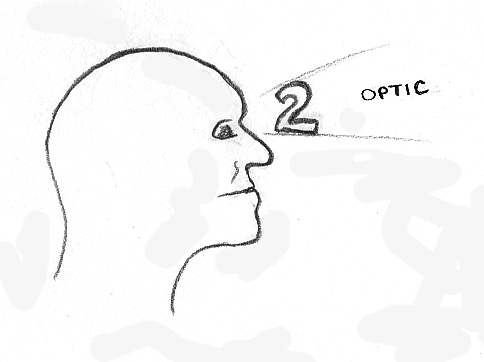
CNII is the optic nerve. It is responsible solely for vision and literally plugs right in to the back of our eyeballs. Some object to it’s classification as a nerve at all because it never actually leaves the brain case. It’s fibers are purely SSA (special somatic afferent).
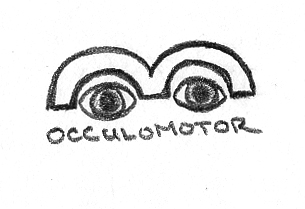
CNIII is the occulomotor nerve. It is responsible for most of the muscles of eye movement, as well as the special eye muscles for pupil dilation and accommodation. It has both GVE (general visceral efferent) and GSE (general somatic efferent) fibers.
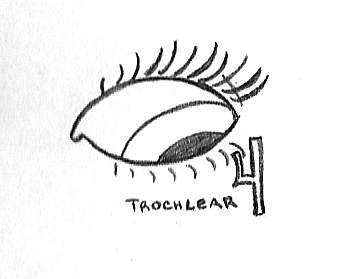
CNIV is a tiny little nerve called the trochlear nerve. It innervates only one tiny muscle, the superior oblique muscle of the eye. This is the muscle that allows the eye to look down and laterally. I like to think of it as a hunter subtly looking down and to the side as their prey gets closer, waiting to get it with their weapon which in my mind is shaped like a four. But that’s just my own little mnemonic. The trochlear nerve carries GSE (general somatic efferent) fibers.
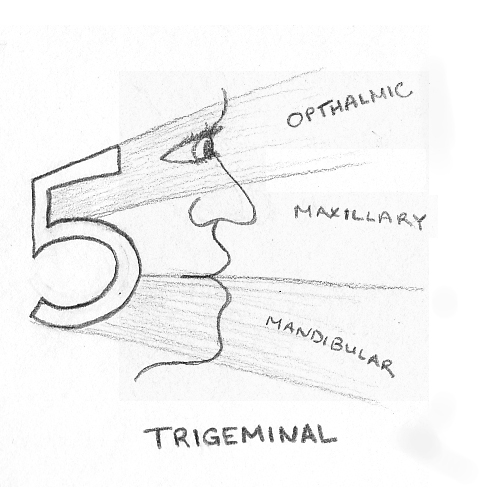
CNV is the trigeminal nerve, and it’s a doozy. It handles most facial sensation, innervates the muscles of mastication, and a few other muscles as well around the mandibular area. It has three primary branches, the opthalmic, the maxillary, and the mandibular. Last spring I had some trouble with my own opthalmic branch of the trigeminal nerve, so I feel like I know this one better than most. The branches come off from the trigeminal ganglion which sits pretty centrally to the head along the dura, just lateral to the area known as the sella turcica. It’s fibers are primarily GSA (general somatic afferent), but there is also some SVE (special visceral efferent) in there as well.
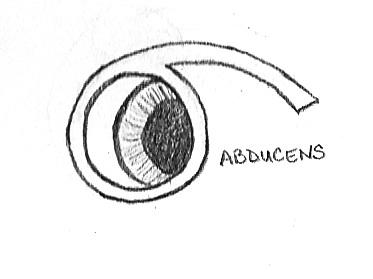
CNVI is called abducens and like the trochlear it is a tiny little nerve that affects only one muscle of the eye. It innervates the lateral rectus muscle which allows the eye to look laterally, which could also be described as abducting the eye (hence the name abducens). It’s fibers are GSE.
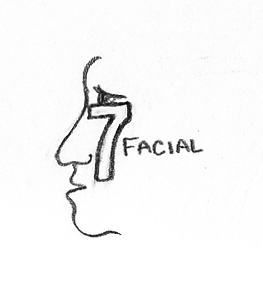
The facial nerve is another big one. It leaves the brain case via the internal auditory meatus and then branches to it’s various tasks. It is responsible for innervating all of the muscles of facial expression. It also sends signals to the nasal, lacrimal, lingual and submandibular glands. And it also receives taste sensation from the anterior two thirds of the tongue. It carries SVE (special visceral efferent), GVE (general visceral efferent), SVA (special visceral afferent), GSA (general sensory afferent) fibers. It’s a busy nerve.
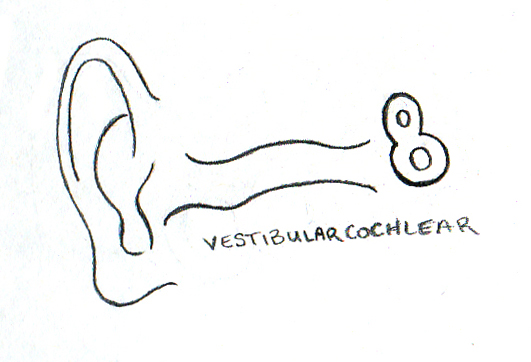
CNIIX is the vestibulocochlear nerve. It and the optic nerve are the only two nerves that carry SSA fibers. It travels along side the facial nerve into the internal auditory meatus. The vestibulocochlear nerve is the nerve responsible for hearing and balance.
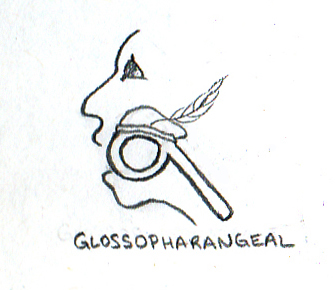
Glossopharangeal is the ninth cranial nerve. My anatomy teacher calls it the renaissance nerve because it does a little bit of everything (hence the hat). It carries GVE, SVE, GSA, GVA, and SVA fibers. It is responsible for your gag reflex, taste sensation from the posterior third of the tongue, regular somatic sensation in a few places, and parasympathetic innervation of the parotid gland, and it innervates the carotid body and carotid sinus.
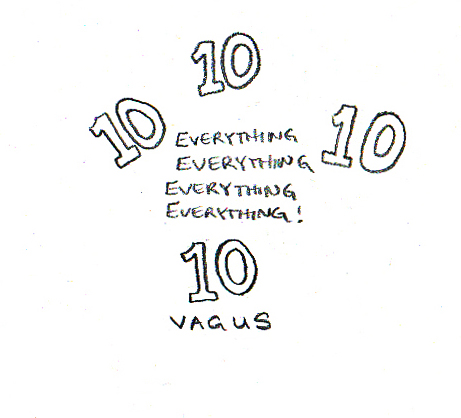
It is impossible for me to think about the vagus nerve without getting that Violent Femmes song stuck in my head with the words “ten, ten, ten, ten, everything, everything, everything, everything!” The vagus nerve is the tenth cranial nerve and it really goes all over the place. It’s giving parasympathetic and sensory innervation to most organs, and also manages to do some things around the mouth and throat. It carries GVE, SVE, GSA, SSA, GVA, and SVA fibers.
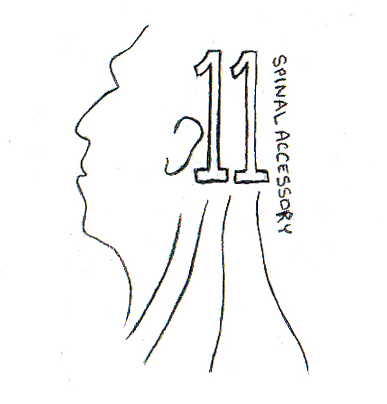
CNXI is the spinal accessory nerve. It gets it’s name from it’s teamwork with some cervical nerves. It also has a bit of teamwork with the vagus nerve, but mostly it’s there to innervate two muscles, the trapezius and the sternocleidomastoid. It carries GSE fibers.
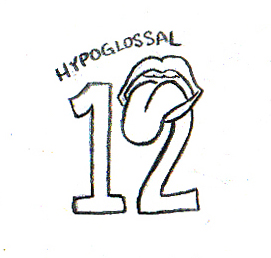
And lastly the hypoglossal nerve which is all about innervating the tongue. Except for palatoglossus, all the tongue muscles are innervated by this nerve. It’s fibers are purely GSE.
Little Skulls
Before I moved to Chicago, one of my favorite sculpting exercises was to sculpt little skulls. This week we finally moved on to the head and neck portion of gross anatomy, and the first thing I did was pull out the skull we got from the class and and few pictures from my textbook and start sculpting again.
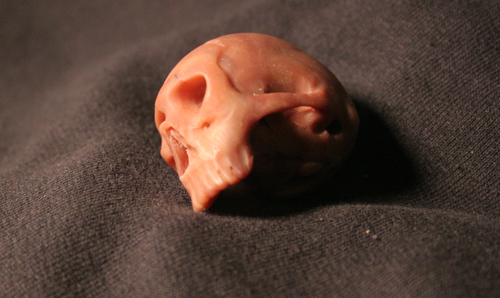
The skull I had in hand wasn’t in too good of shape, so I wound up trying my hand at a skull without a mandible for a change. This wound up being fun, because I wound up paying much more attention to all the little foramen and structures on the base of the skull than I normally would. There are so many little nooks and crannies.
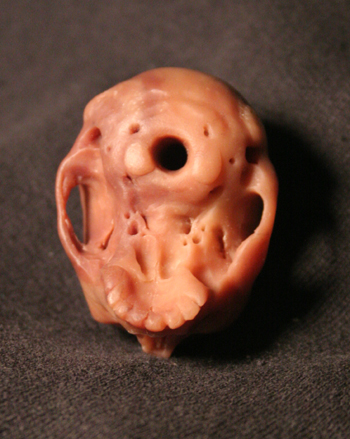
It’s far from perfect, but a good exercise nonetheless. And who knows, one of these days I might just get good at this.
Sayaka Isowa’s Conjoined Twins
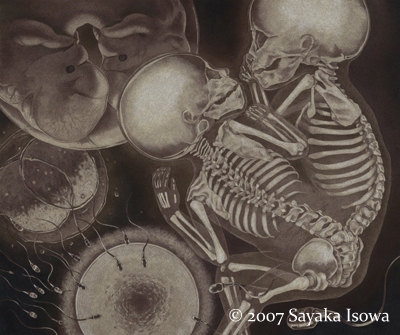
One of my classmates created this, and well, I just think it’s wonderful.
Her name is Sayaka Isowa, and she keeps her own blog at http://sayakaisowa.wordpress.com/
2009 Armitage Lectures
Last week we had the 2009 Armitage Lecture Series at UIC. Thursday’s speakers were Noah Lowenthal, Greg Blew, and David Bolinsky. Friday we heard Edmond Alexander and Dr. Luc Renambot. And of course, special guest Frank Armitage was there.
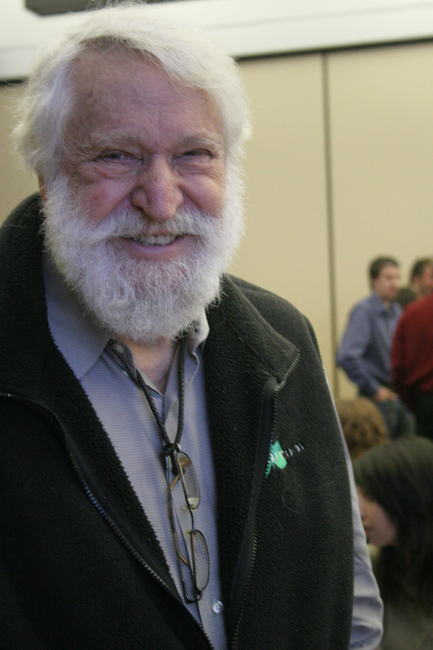
The lectures largely addressed medical animation, the business side of medical art, and the Disney influence (particularly Frank’s influence) on so many medical artists today. I think what I got out of the lectures most of all, was the importance of following one’s vision, and the potential for carving out one’s own niche. These are important lessons, though they are easier said than followed.
I have posted photos from Thursday’s lectures here. Many thanks to program director Scott Barrows for making this lecture series happen. It is an annual event, and if you find yourself in Chicago next fall, you might think of looking into making it by UIC for the next round.