Medical Instruments
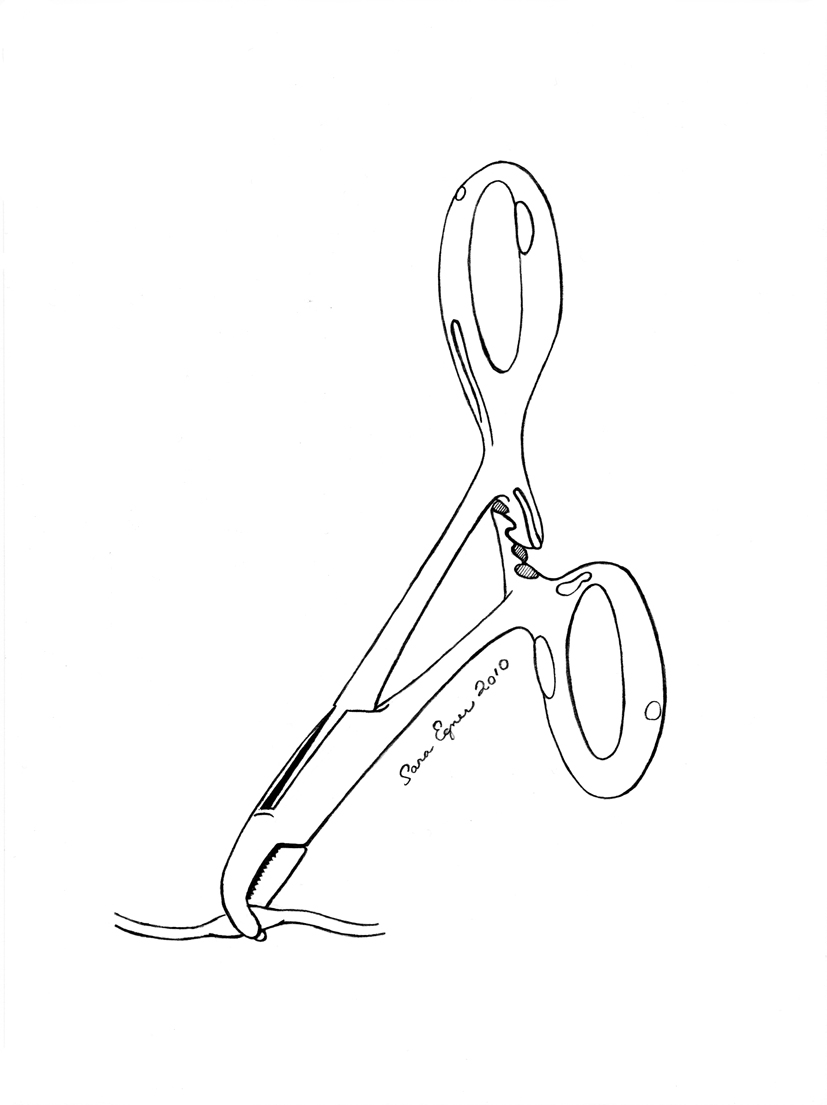
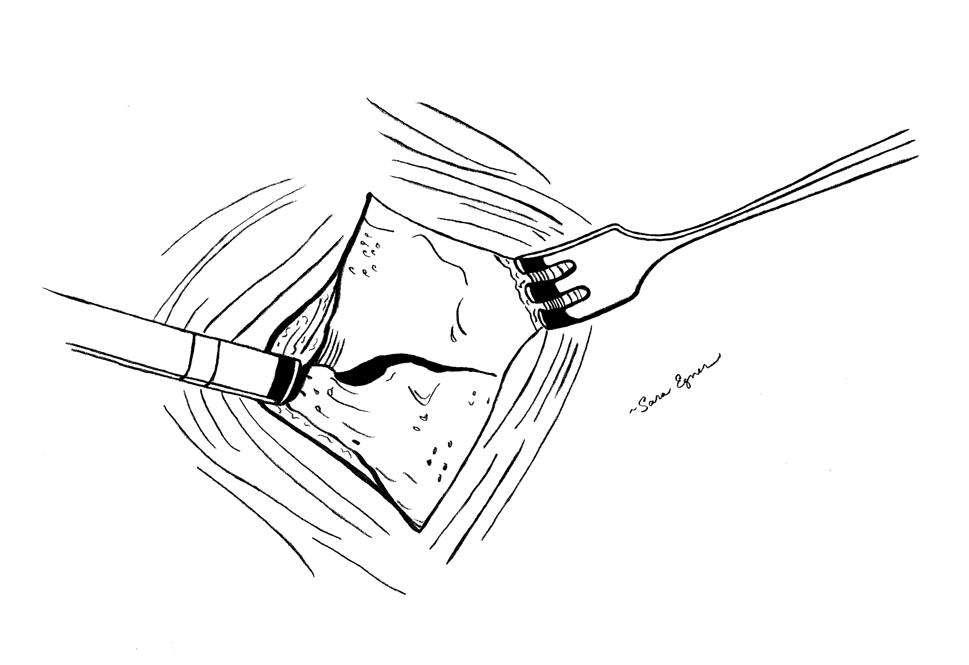
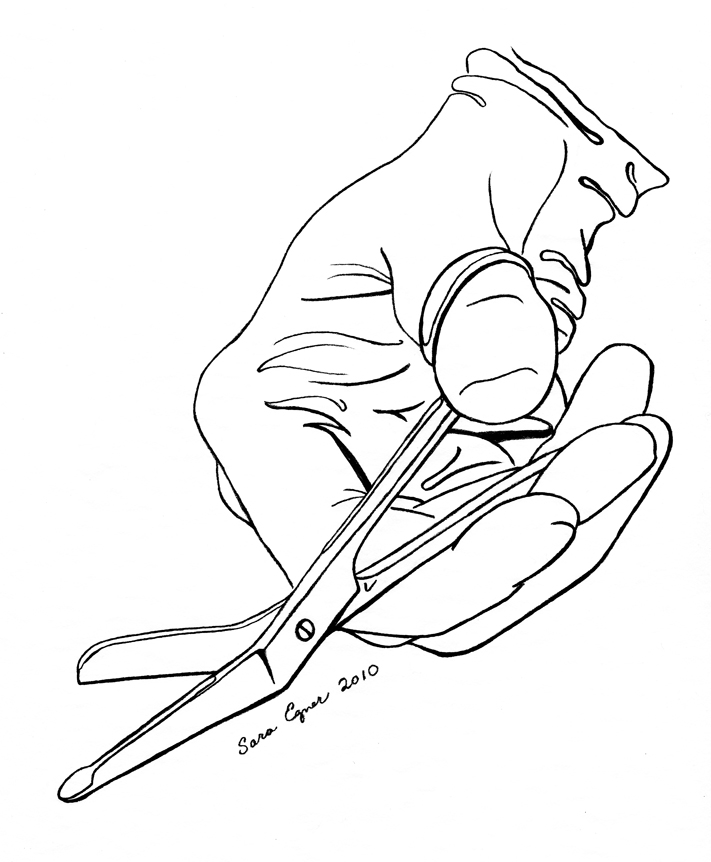
These are just a couple of drawings I did this summer for a class. The focus was on medical instruments. I thought I would go ahead and post them here.
AMI Conference – Part 3
Wrapping up this recap of the AMI conference, I suppose I should come back in with Saturday morning. The first lecturer was Leon Speroff, MD who spoke about the beginnings and history of oral contraception, focusing specifically on Gregory Pincus and his work in creating the birth control pill. The talk was really very positive, but I couldn’t help thinking that I am so glad not to be one of those women that fell into the trial and error portion of learning about the pill.
After that Graham Johnson and Brad Marsh got up and spoke about their work visualizing the pancreatic beta cell with the use of electron microscope tomography. The big finale is that they are putting together this really extensive 3D atlas of an entire cell by collecting data from smaller scans which can collect better data than anything you can view an entire cell under so far. This was some really cool work.
Then Scott Fassett got up and spoke about Illustrating for the animation industry. Most of his work was with Disney. Beautiful work, but I have to admit to being a touch burnt out on the magic of Disney from my time in LA. The techniques he discussed were not ones I am likely to use myself, but it was a nice introduction to them.
I would say I found myself the most interested in the panels which followed next. First on the list was “From Concept to Completion: Real World Development of High End 3D Medical Animations (Part 1 of 2), and then the continuing panel discussion which was part two. these really brought home for me the value of having a full company from which to do business. They seemed to have found ways around some of the pitfalls I myself hit in trying to do freelance work right out of college the first time, and a lot of it came down to having the staff, resources, and clientele base to allow a client lots of time to make decisions or change their mind while you are simply working on something else. That ability to have multiple jobs going at one time struck me as a matter of key importance. It just isn’t possible to juggle like that while marketing yourself and arranging for new clients when it is just you doing everything.
After that there was another panel discussion that fed right in to the same momentum, called “Your Future as a Self-Employed Medical Illustrator: Starve, Survive, or Flourish?” This brought out a lot of concerns amongst self-employed medical artists, some of which became rather heated as the discussion continued. From concerns about marketing, to the increasing outsourcing of jobs overseas, to reinventing ourselves into more complete service providers and resources, there was a lot to take home and process from this discussion. Business has clearly changed in the last decade or so, and a lot of people are struggling to find new ways of doing business to keep on top of those changes. I really heard reiterated again and again throughout the conference in it’s entirety, that the push is to offer a more complete service, rather than marketing our work as a final product. For one thing, we tend to be better at using our illustrations and animations than just anyone putting things together, but we also become more useful to employers when they can hire us to provide a more complete solution to their needs rather than just another piece of the puzzle that needs further management to bring it to it’s audience.
I had to duck out of the panel discussions just a touch early to get back to the room and dress for that night’s banquet and awards ceremony.
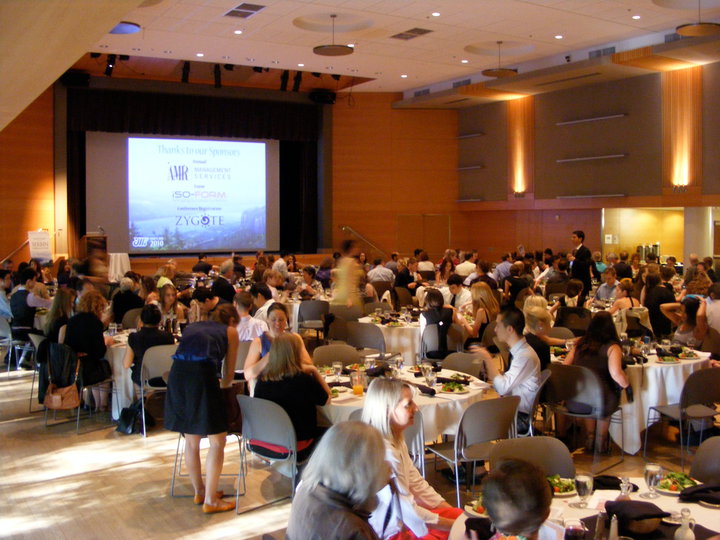
I was signed up to work this one, so I needed to be there a little bit early. This was a lovely event where everyone dressed up and we had a nice dinner catered while the awards from both the salon entries were given as well as the larger awards recognizing life long achievement and such. Being so new to the crowd, I think I was most excited to see our very own Matt Cirigliano‘s work take an award.
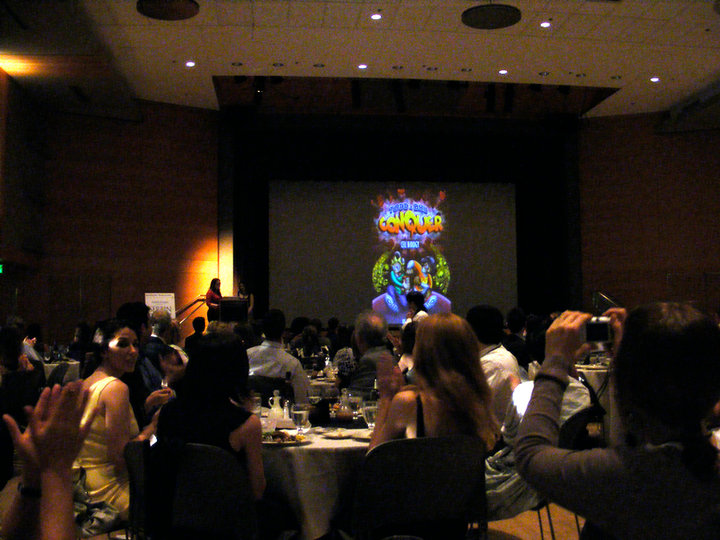
Congratualations Matt! And thank you Josy Conklin for the pictures!
If I find out it’s posted anywhere, I will come back here and edit this post to provide a link, but Matt put together this fantastic comic book to teach young students about cell biology. The parts of it that I have seen look phenomenal.
After the awards ceremony people milled about a bit longer and had those last chats and goodbyes before we all went off to whatever the night held. I believe for some of my classmates it was karaoke, but for me it was Bridgefest. I was told a few days prior about the 100th aniversary of the Hawthorne Bridge, and some very lovely friends of friends wanted to take me to the celebrations. I missed the big band and party on the bridge itself, but made it out to the celebration afterwards just at the end of the bridge featuring live music, beer sales, and fun people all around. I was even so lucky as to get a comfier room to sleep in that night and an early ride out to the airport with my new friends in the morning. Not a bad way to end my Portland tour indeed.
Business Cards
Well, I’ve finally done it. I’ve ordered some business cards. This time I went through Moo, rather than the simple home print I’ve been getting away with, or Vista (my last professional card printing). Moo is nice in that you can upload an image to both sides of the card, so you can really design the whole thing in Photoshop if you want. I went with the same original drawing for artwork as last time.
See my last card…
I noticed last time that business cards don’t just go to business contacts, and handing newly met people who were not in medicine or art a card with breasts like that got a reaction once or twice, so I decided to alter my use and focus on the skeleton and organs this time. I also decided that in this day and age, having a land line printed on anything other than a company card, just doesn’t fly anymore. Everyone texts these days. So even though it is still true that my land line is more reliable than my cell phone, I went with printing the other number this time to better meet with people’s assumptions. Plus I’m getting better and better at the things I do every day, so maybe it’s time to have a more permanent number listed. I don’t intend to change that number any time soon, and in fact it is still bears my old Los Angeles 323 area code.
I also went for a little more information regarding what I do this time. This can be difficult when one’s specialties are broad. And there is always the debate of whether one should say the least amount possible and let the name stand alone, or the most possible. This time I worked some clues into the back of the card. I wanted a title that was applicable to the wide breadth of specialties I now have to offer, so I went with creative solutions specialist.
Here is the new card, front and back…
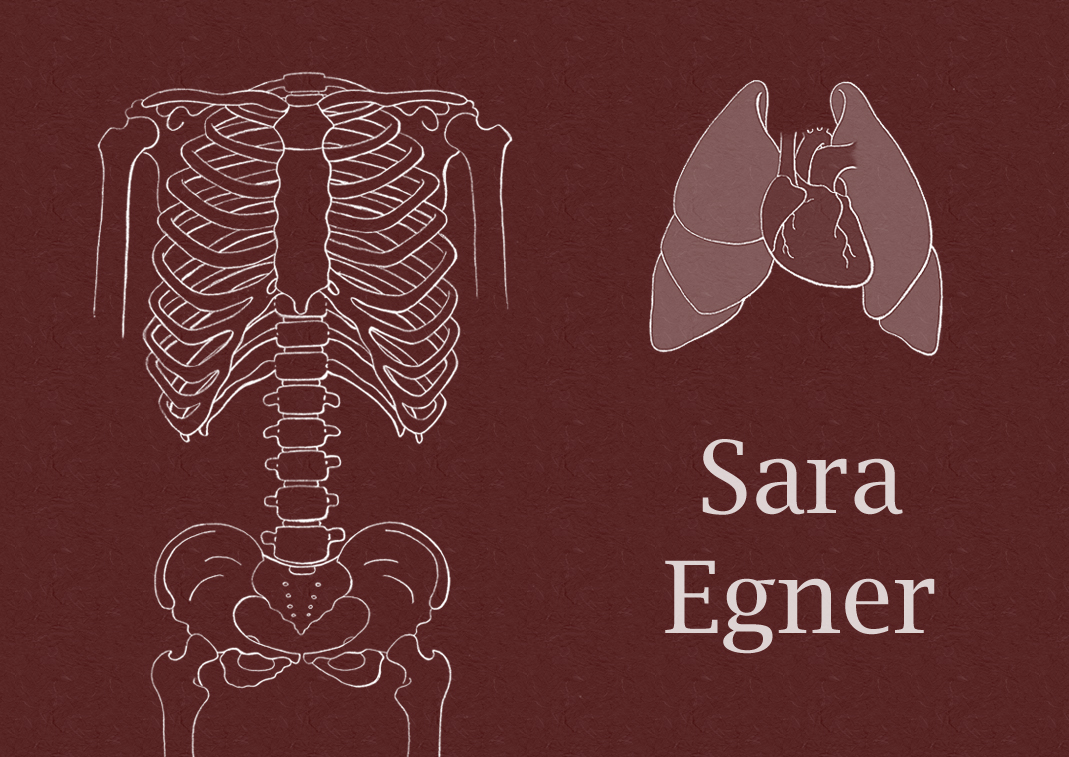
Well, they’ll actually be cropped just a touch more, particularly at the top and bottom. I had to do some finagling with the bleed to get the image to align correctly in the card’s design interface online. For those of you who don’t speak printing language, the bleed is just your extra image in place to cover you in case of shifting or other variability in a printing situation.
I am happy to have been able to only grab a small package of cards this time. That way I’ll have some in hand, but I don’t feel so wasteful. The last time I made such a purchase it was for 250, and that was simply too many for my purposes. I still have cards floating around that give my old LA information. Moo allowed me to print just 50, which I think will be perfect. The way I see it, by the time I’m out of school and back working again, I’ll probably have some different ideas about how I want my card to look anyways, and that isn’t far away at all.
Poke-a-Brain Flash Interactive
Just taking a moment away from the AMI recap to show you one of the major reasons I haven’t had a chance to finish the AMI recap. I’ve been putting together my very first Flash interactive, and it’s called Poke-a-Brain!
I am personally pretty floored at how much work has gone into this. For such a silly little interactive, I got in over my head with a couple of the tricks I wanted to pull here. From the moment I went to coding outside of the code snippets I was a mess, and only by the grace of good friends did it ever come together in it’s final state.
If I want to keep doing these, I have a lot to learn about coding and coding languages. But here’s my first run.
AMI Conference – Part 2
So, to continue the telling of my own personal AMI experience, I suppose I should jump back in at the annual business meeting. Apparently the AMI has this formal meeting every year during the conference. As a student member, it was a little strange being asked to attend but not as professional members and therefore not to vote. One couldn’t help but raise an eyebrow at the required box lunch purchase followed by the realization that it was to get us at a meeting where we were to remain silent. Just the same, it was an effective tactic. And the meeting did actually provide some good insight as to how the AMI works, and where it stands today. We seem to be recovering from a recent slump in member numbers over the past several years now. There seems to be a lot of attention to ideas of branching out, and reinventing ourselves to meet modern needs. One gets the impression that the medical illustration industry has seen a lot of changes in just the last decade and that there is a lot of uncertainty and just flat out differing opinions out there regarding how best to proceed, be it as individual professionals, or as the AMI group in it’s entirety.
Since that first day, Emily and Meggan had planted the seed that we should pay attention to our observations as first timers. I guess the thought stuck with me, and I spent a lot of the business meeting jotting down the basic umbrella problems I was hearing alongside my own ideas for little things that might be worth trying. Sadly I never did manage to get that idea board in my sites, so my thoughts were never really submitted anywhere. Mostly I just made notes about things like having an open night with friends and family and local medical professionals and students (we were on a university campus) to increase the public’s awareness of us and give attendees an easy opportunity to visit with local friends and family, or creating a separate supporter level AMI membership, or maybe just a magazine subscription. I figure the work we do is interesting and a couple blurbs, a few interviews, or even just pages of the work submitted to the salon by willing artists would be pretty cool, get what we do out there a little more, and raise funds for the group. I think the rest was just doodles and something about viewing spaces for animations and interactives.
After the meeting I went into my first shift working for the event. I had been assigned to work the techniques showcase that afternoon. As it worked out, I found myself stationed in a room with Nick Klein and Wes Price. Nick presented some useful action scripting techniques for Flash, a bit of which I have every intention of using in my Poke-a-Brain interactive in the coming week. Actually, I felt very fortunate to have someone putting out such useful tips while I had my laptop on hand and could work on my own interactive. He even took a look at it with me at one point when he had a break between sessions. I had a few people comment while I had that up actually, one of which was an artist who specializes in neuroanatomy. He told me about a professional project happening that follows a similar structure, though it is being done on a larger scale. I guess I’m not the only one who wants to poke at brains!
And then Wes Price was a pure inspiration with his stop animation pieces. Any concern about working on something so silly as my Poke-a-Brain interactive in such a professional crowd was easily abated by the fantastic ridiculous clips he was showing. I’ve never really picked up stop-motion myself, other than maybe that one project back in my film school days. But it’s hard not to love the medium as a viewer. Somehow I kept happening to catch one of his closing statements “If it’s not tedious, it’s not animation.” I guess that one stuck with me, and I think it’s going to be running through my head a lot in this week to come, as I work to finish up so many end of semester projects. Creation takes time and I just have to remember that I’ve put in the hours before and I’ll put them in again the next time.
Well I wish I could say I was able to listen to both Nick and Wes in full for their showcase presentations. Instead I found myself with the task of managing the Adobe CS5 Design Suite raffle, and giving out 30-day trial CS5 disks. Having only just recently upgraded my own software to CS5, I was actually pretty familiar with what software comes with the different packages, and found myself ready to answer more Adobe questions that I would have guessed I’d have remembered about the stuff. A lot of people mistook me for an Adobe representative. But no, I’m just slow to make purchasing decisions and apparently have been keeping a lot of those package and software comparisons running in my head since the last time I had to do it.
That night we had the silent auction followed by the live auction. I was a little bit jealous of the arm bone model that Julia Klein came away with there (from scapula to distal phalanges), but over all I was very good about not throwing my money around. I suppose that kind of thing comes more naturally when there isn’t much to throw. This night was a big fundraiser night, but it was also fun. There were lots of raffles, and one particular fundraiser event where we moved these wooden beavers along a grid as money was donated from the various schools attending toward the Vesalius fund. Each school had decorated their own beaver, and the race was on.

*photo by Kylie Bergam
This actually wound up being our earliest night to be left to our own devices and a bunch of us agreed to meet at Deshutes downtown for a drink. Actually I think a lot of individual groups from our conference made the same move. Great minds think alike I guess. But there were so very many of us, that we found ourselves with a long wait to get a table. So Josy Conklin (who was also my roommate for the conference) and I decided to make a crash run over to Powell’s Bookstore, the famous bookstore that covers an entire city block and gives you a map upon entry to navigate their many rooms. Thank you Josy, I am soooo glad we did this. But at the same time, I can’t help but laugh at the fact that such a giant bookstore was sold out of the one book I was looking for. One of the speakers had mentioned a book about Mitochondria called Power, Sex, Suicide, Mitochondria and the Meaning of Life, and I was curious to check it out, but I guess someone else must have had the same thought. Oh well. I wound up picking up a copy just recently though, and it looks really cool. I can’t wait for the last dregs of this semester to finally wrap up so that I can have the time to read again.
We made it back to Deshutes in time to have a lovely night out with classmates soon to move on, and new acquaintances, and in my own case I had the pleasure of getting an old friend to come join us. With as much as Portland reminded me of my early years in Austin, what a fantastic surprise that two of my old friends/ neighbors from Austin were living together again as roommates now out in Portland. And one of them, Ashley Miller, chef extraordinaire, came to visit us that night and meet everyone.
And once again I’m back to working on projects, and will have to postpone the continuation of my Portland story until I can return!
AMI Conference – Part 1
Hello Readers! Today I write to you from a plane, returning from Portland, where I have been attending the 65th annual conference for the Association of Medical Illustrators. So far this entire experience has been amazing. I feel that I have truly been surrounded by knowledgeable and talented people over the last week. And all of this against the backdrop of Downtown Portland, which has made quite an impression on me itself. We kicked things off on Wednesday morning with a first timers workshop to get us all acquainted with the basics of how these meetings go. Emily Shaw and Meggan Foldenaur did a great job of fostering a friendly environment for us first timers to meet each other and ask questions about how these things work. David Bolinsky also spoke to us a bit about his own artistic journey and work creating the company Xvivo in collaboration with Michael Astrachan, who was also there attending as a first timer, and a handful of other brilliant folks who were not in attendance.
Later that evening we had the Salon Opening Reception, which was a real treat. There were literally hundreds of submissions of medical art to check out, and most of the creating artists right there, many of which choosing to share their accumulated wisdom with the lot of us. Overall the AMI has shown itself to be a very friendly and inviting crowd.
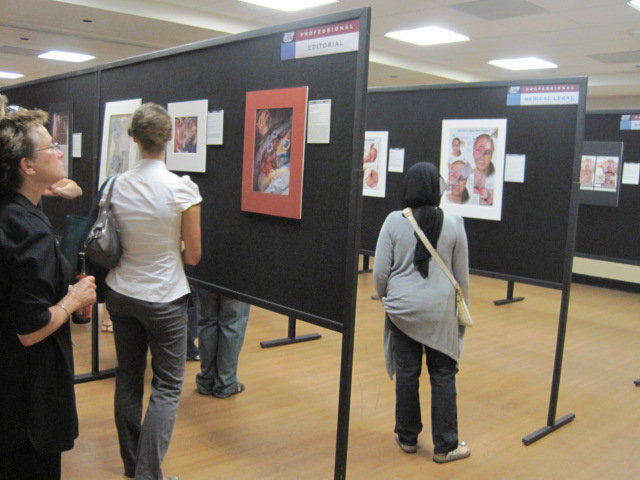 *special thanks to Kylie Bergman for her pictures!
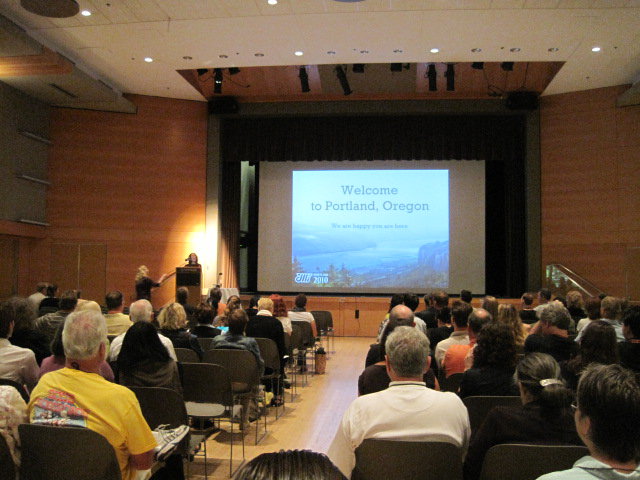
Thursday morning started with a welcome to Portland talk, which was quickly followed by Dr. John Hunter‘s speech on both the history of Max Bröedel as well as a really helpful overview of how surgeons learn from medical illustrations and what makes an illustration more or less useful to them. This was followed by Tim Girvin‘s presentation entitled “Design for a New World.” Not being particularly drawn to design myself, I wasn’t too excited about this one, in fact I even considered skipping it. But I am so glad that I did see it. I think that more than a presentation on design, Tim delivered to us performance art on life and living as an artist. You kind of wanted to hug the guy by the time he was finished.
After that Betsy Palay got up and spoke about finding new opportunities and expanding our definition as medical artists in her presidential address entitled “In Search of Invisible Lizards.” Here she compared the strangely unnoticed giant pink iguanas of the Galapagos to the opportunities in front of us that we regularly fail to see by simply not recognizing them for what they are.
Thursday afternoon, after a nice lunch outing to the famous food carts of downtown Portland, I had a chance hear the Vesalian scholars session and get a glimpse at just what kind of projects took home the big money that I failed to get with my own application for my own research last year. Neil McMillan spoke first about creating a model to help explain the pharyngeal flap procedure to patients and their families with velopharyngeal insufficiencies due to a cleft palate. This was really cool, as I initially assumed that he meant to create a digital model, and found myself obsessively writing notes about that sculpture idea I’d had back in Dr. Reisburg’s maxillofacial prosthetic’s class to explain this very procedure, only to realize that Neil was only using digital tools to arrive at a physical 3D model. I’m a fan of good anatomical models like that, so I thought that this was pretty cool.
Then Shizuka Aoki got up and spoke about her research with incomplete midline closures, which is the underlying cause of cleft palates. Her work has been more targeted at visually communicating information about these cases to medical professionals and students of medicine, and she is doing some fine work to that end.
Then Gwun-Yee Chin presented his own work in laying the groundwork for computerized programming intended to study the movements of patients with autism via motion capture. The program allowed for various means of seeing and measuring the nuances of movement in a patient by utilizing a standard gaming program and setting it up to instead acquire patient data.
And lastly Elizabeth Weissbrod, who if I remember correctly from meeting her at the salon opening more commonly goes by Besty, got up and presented her Flash interactive about Malaria. From what I gathered from her presentation, the easiest way to stop malaria is to stop it in the mosquitoes rather than the humans, but the easiest way to reach mosquitoes is to inoculate the humans from which they feed. It’s actually a rather elegant solution to the problem, except that most humans aren’t too keen, nor should they be, about receiving injections that do absolutely nothing to protect them against malaria directly, but instead can only help stop the spread of malaria after they already have it, from being passed via mosquito onto the next person. The interactive does a great job of educating its audience about the details of this matter.
After the Vesalius presentations I actually departed on a unique opportunity not scheduled by the AMI. The previous night, my classmate Kylie Bergman, who also studies anaplastology with me, introduced me to Fred Harwin. We knew about Fred Harwin, because Bob Brown in the clinic at UIC had told us about him when we were learning to make acrylic eyes. Fred Harwin is a well known ocularist and medical artist who resides and works in Portland. He is particularly well known for his prints of irises with surprise pictures inside, and also for making ocular pieces with hidden images or logos just to the edge, something personal that the patient requests. This practice speaks to some of my own thoughts and ideas about anaplastology in a very fundamental way. From the moment I first learned about the field, I was interested in customizable pieces for patients, not just in the way they match the patient’s own anatomy, but also how they might reflect the patient’s personality, even if it means diverging from realism to do so. This isn’t something that I’ve spoken much about here, in part because I have wondered if the idea’s lack of existing popularity is a product of more knowledgeable anaplastologists knowing better already. So you can imagine that it was exciting to see someone so well established in the field practicing similar ideas already in his own way and with great success and appreciation amongst his patients.
Anyway, that afternoon, Fred Harwin offered Kylie and me a tour of his own clinic in Portland. Naturally we both accepted. I believe this now makes five clinics I have visited, though this was my first to visit that specializes in ocular pieces. And every time I visit one I get a little better sense of just what all one really needs to do this kind of work, and why people are making the kinds of choices that they are when setting them up. It was a great little outing, and Fred was so encouraging of the new energy that he saw in both Kylie and myself to the field. In fact we had such a good time that we wound up stealing him away to the UIC alumni dinner that night. And let me just say what a pleasure it was to meet so many UIC alumni faces, previously unknown, and in particular I’d like to just mention quickly Julia Klien who may just be a kindred spirit in her own right, and Alice Katz, who really founded the anaplastology program which I now attend.
After dinner, my classmates along with a few of the more recent grads decided to go for a drink or two at a nearby bar. Indecisiveness on the choice of bar wound up leading to me marching the lot of us into the next inviting bar I saw, which turned out to be a gay bar, and apparently I was the last to notice this. We had fun, though I did feel a little concern over the comfort level of one or two members of our party, particularly when a few performers from the drag show down the street stopped by with more than a few words to say to our party’s gentlemen. Tasty beer in bell jars, good company, and an easy table for us all to talk was pure win though.
Friday morning I missed the first lecture, but made it over in time to catch Dave Mazierski on Modeling Mitochondria. Some of you reading may already know that one of my best friends is a little obsessed with mitochondria. And while it is true that they are not ultimately part of our DNA and even have their own DNA to speak of, I’m not sure that I quite agree with my friend’s take on them as alien and threatening (though it is a fabulous conspiracy theory). They are something that has been a part of us throughout the entirety of human existence, and may even be the key that made our complex life form possible in the first place. And while they do call a lot of shots inside of our own body, including that of when a cell dies, I don’t so much worry that they are up to something. Rather I find myself wondering if these little guys might not be the key to curing cancer. Perhaps if we managed to communicate somehow and send them to killing off cancer cells specifically, we could finally rid ourselves of the chemotherapy and radiation treatments used today which our good healthy cells only barely manage to survive. But that is another tangent for another day. Suffice it to say that it was a real treat getting to hear Dave Mazierski’s take on these fascinating tiny creatures. In his talk, he went into the discovery of mitochondria, the history of how they were studied, and ultimately what do they really look like. We have all seen the same jelly bean with squiggly lines inside image of mitochondria before, but Dave has been working to discover their true form. And by true form, I mean the multitudes of variations on form that we find in mitochondria, and which are present where. So yes, this was a very cool talk.
And in the interest of getting my semester’s end schoolwork done on time (I have now long since put my trey table back up and returned my seat to it’s upright position for landing), and in giving you all reading a break, I will postpone the continuation of this recap for a later date. In other words…
… to be continued!
The Image of Research at UIC
Recently UIC held their annual competition called The Image of Research. The idea is that graduate and professional degree seekers at UIC have the opportunity to submit images of aesthetic appeal along with the connection to that student’s research here at the university. This year, one of my classmates, Annie Campbell, took third place with a piece she did for one of our classes illustrating the photoreceptors of the retina.
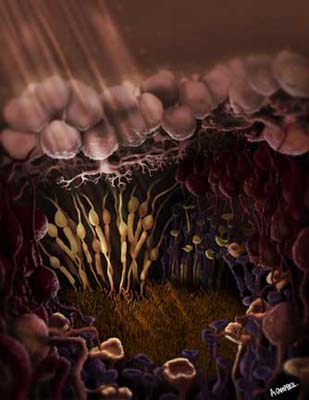
Just recently, the following article was released in the UIC news which includes an interview with her. It’s a fantastic piece, and Annie is an incredibly talented artist.
http://www.uic.edu/htbin/cgiwrap/bin/uicnews/articledetail.cgi?id=14385
First place went to Sangyoon Lee for research being done to create a graphical computer interface with a very life like avatar, that can be rendered in real time allowing for real time interactions. In fact, they’re even calling the project LifeLike. So they submitted an image of the man they have been working on showing both the rendered side and also the wireframes. It looks like they are getting some great results.

And second place went to Kristin Thomas for her image of an evaporating dish containing an arry of disks cut from PEGDA hydrogels synthesized in their lab. This one is too far outside of my realms of expertise to be able to give much in the way of comment, but I will post the image nonetheless.
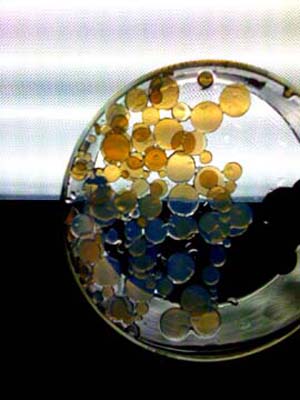
Congratulations to everyone who placed in this contest. You’ve all created some great work!
Flash Interactive in Pre-Production
So, last night I posted an example of a Flash interactive that I thought was cool. Tonight I thought I’d go ahead and post the wireframes and screen flows I’ve been working on. I *think* I’m doing this right.
First, the screenflow chart…
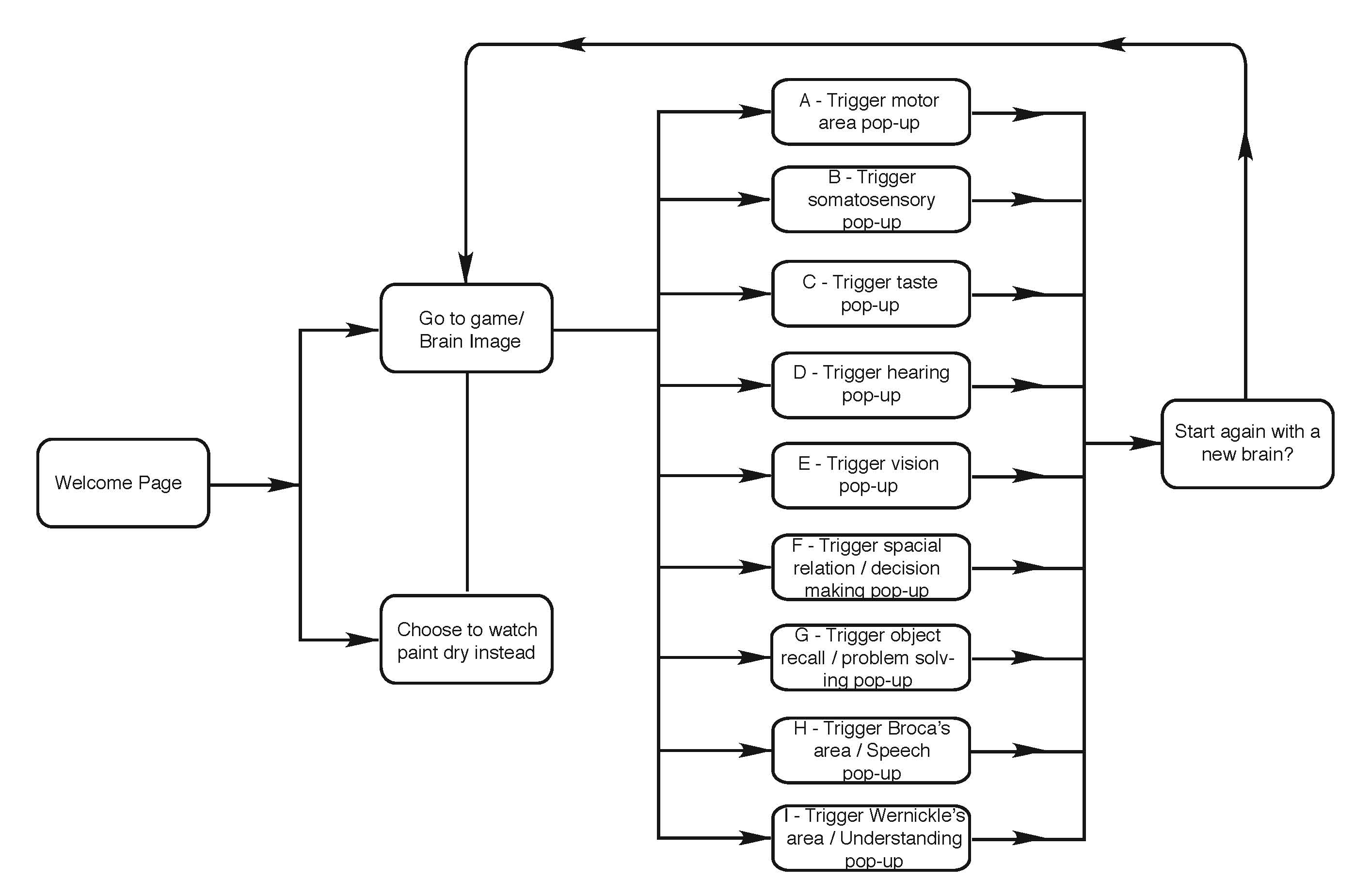
And once I had the screenflow down, I moved on to the wireframes. Now as I understand it, these are drawings meant to express the layout of your interactive without the distraction of color. The idea is to look at screen placement, and to create a map for the work to come.
In my case, I have come up with three images. The first is a layout for how my welcome page will look.

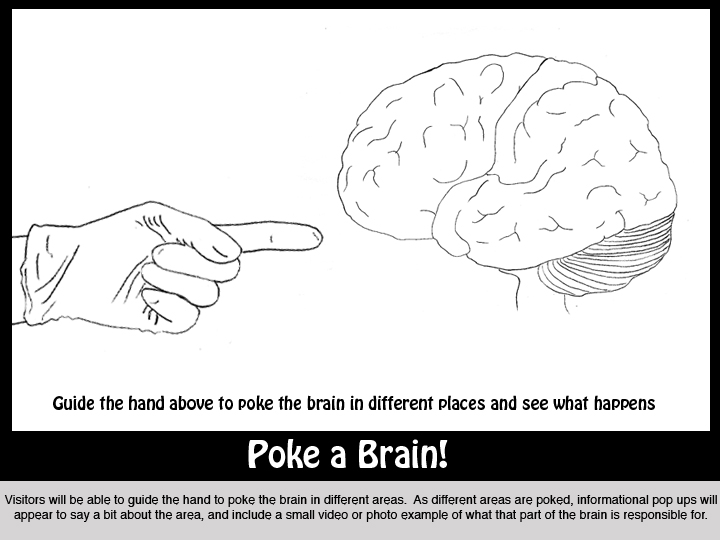
The second is what the game would like like when the visitor first arrives at it, before anything has been clicked or moved.
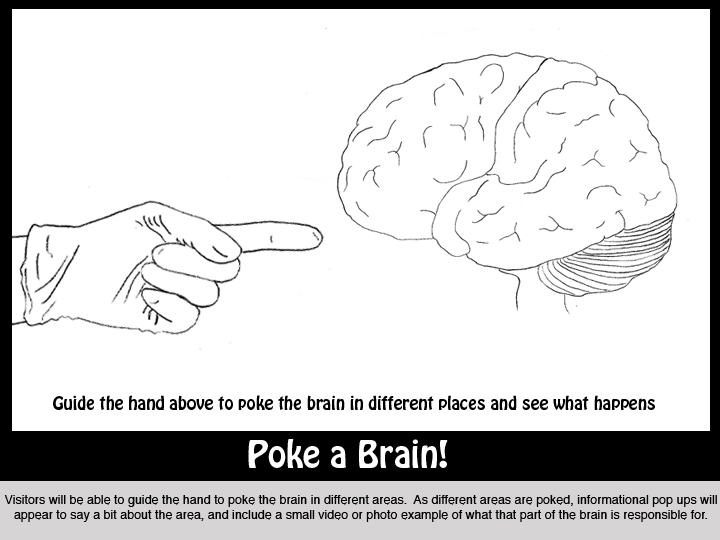
And then the last image is a layout for how the individual pop-up windows will be handled.
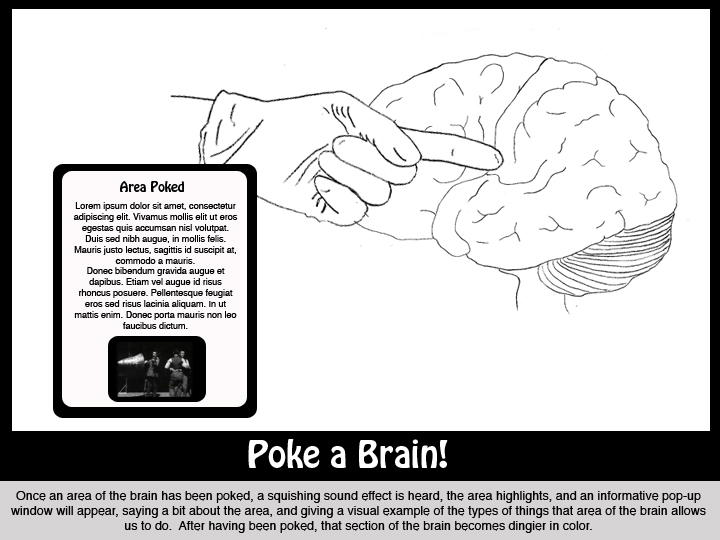
Well, here’s hoping I’m on the right track with this! And remember, if any of these images are too fuzzy to read the text from, you can always click on them which in this case will make them bigger, but always seems to make them clearer regardless of any resizing I’ve done.
Mouse Party – from the University of Utah
So we’ve been doing some work with Flash this summer, and we’re designing basic Flash interactives. It sounds like they are a lot of work to put together, especially if you don’t know what you’re doing. Personally I’m still mind boggled at the idea that I sometimes have to use two equal signs to mean something is really equal. My plan is to put together a little interactive where the user gets to poke at a brain and learn a brief overview of how the various areas are organized up there. So far I only have a screen flow chart, so that’s only a little bit exciting. But I have found myself thinking back on an interactive a teacher showed us in our first year with the program called Mouse Party. The more I learn about what goes into these, the more impressed I am with this. It’s fun, it’s creative, and it’s informative. And the animation is so stylish and clear!
http://learn.genetics.utah.edu/content/addiction/drugs/mouse.html
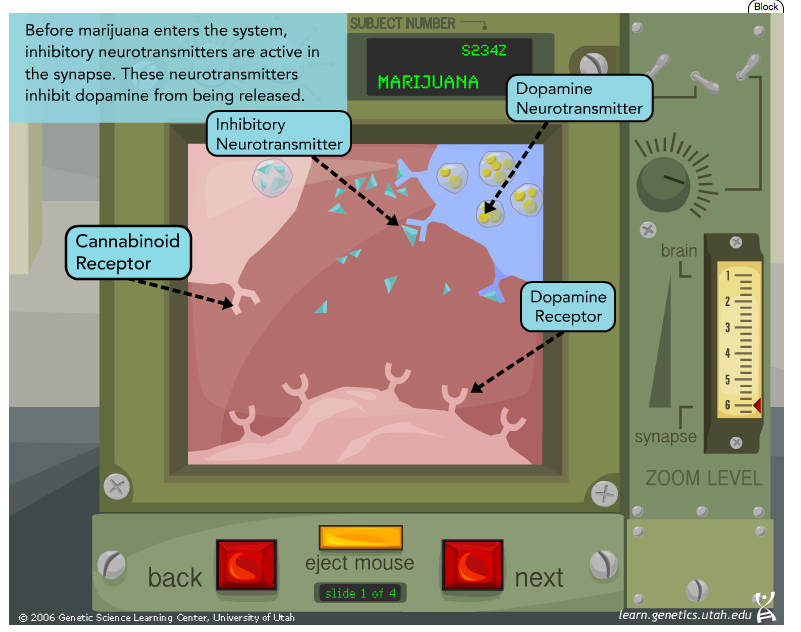
Check it out!
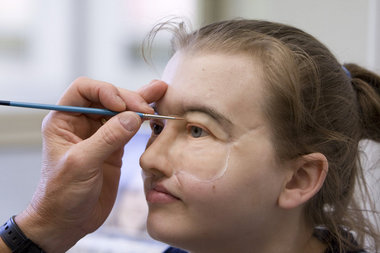
An interesting anaplastology case in the news
Interesting article about an anaplastology case…
http://www.oregonlive.com/health/index.ssf/2010/07/chrissy_steltz_tries_on_proste.html
It sounds like the injury itself was a terrible tragedy, but the work done for her has been extensive and good.