Paint-On Anatomy
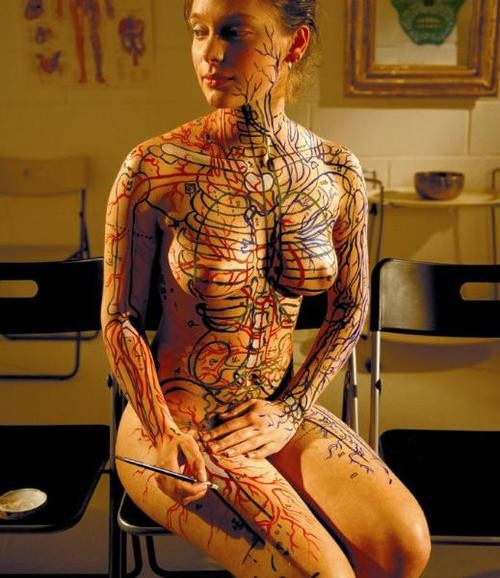
I just love this image. I wish that I knew who had created it. I found it through the findings of friends who use Pinterest. I imagine that there is probably a whole photoshoot out there somewhere. It looks like too much work to have only taken an image or two.
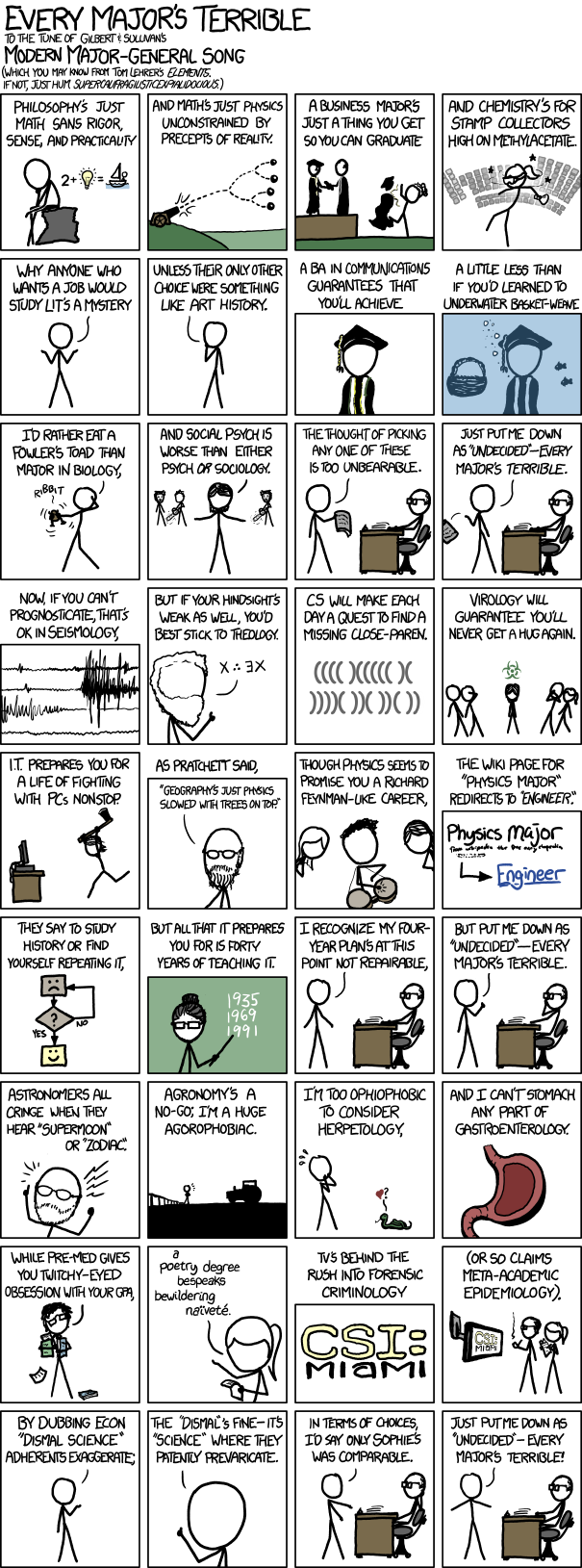
XKCD – Every Major’s Terrible
It’s been a while since I’ve posted any XKCD comics here. And this one was so cute (and also well timed for all the graduating high school students looking into further academics out there)
The Enzyme Substrate Complex
So, some of you may remember my recent post, “Molecules Molecules Molecules.” Well I’m really psyched to be able to share the animation that inspired that post with you all online now.
Enzyme Substrate Complex from sara egner on Vimeo.
I’m excited to get to show a little bit of the kind of work I’ve been doing lately over at Sapling. And I’m glad I get to share this one in particular because I know it goes just that extra step beyond the kinds of videos you find on this subject out there. And I’m loving that we get to make things like that. I get to work with biology experts. And when things get really really tiny, no one says, well that’s really just chemistry at that point – don’t worry about it. We just talk to a chemist about it. And if I hit a technological glitch, we have those kinds of experts around too. And I’d thought that my move into grad school was going to be a move away from all the video work I used to do. But here I am drawing back on all of that experience to make things like this now. And of course my whole little fascination with ATP comes in to play with this one. But that would be a whole other story. And this writer is winding down for the night.
Histological Visualization
Perusing through some news today I found a few articles siting new software that is bringing 3D visualization into the histological realm. Basically they are taking histological slides and using the same type of algorithms that CT and MRI use to generate 3D images that can be moved about in space and studied.
Reading these, I was really surprised to hear that such a thing hadn’t already existed. It seems like something that you could do with Mimics honestly. But I suppose it was the actual data collection at the microscopic level that wasn’t quite available. Without a scanner doing the registration for you, one is left with having to work out each individual slide’s relationship to the next, and that could certainly eat up some time. But Dr. Derek Magee at the University of Leeds seems to have found a good way of handling that. So the person using his software scans in prepared slides, and the alignment happens automatically and a 3D image is presented.
I find it puzzling that these articles about the technology keep referring to the scanners as “virtual slide scanners.” It doesn’t sound like there is anything “virtual” about them aside from the end result they produce of allowing a virtual 3D image. Every description seems to talk about an actual physical slide being scanned for digital information. That sounds like a scanner to me. But I leave that one up to any of you reading to decipher whether you think I’m just missing something, or someone early on was quoted while trying to push technological buzzwords. In my experience, either of those things could easily be true.
The work has been published in The American Journal of Pathology but is also discussed in these articles.
http://www.medicalnewstoday.com/articles/244203.php
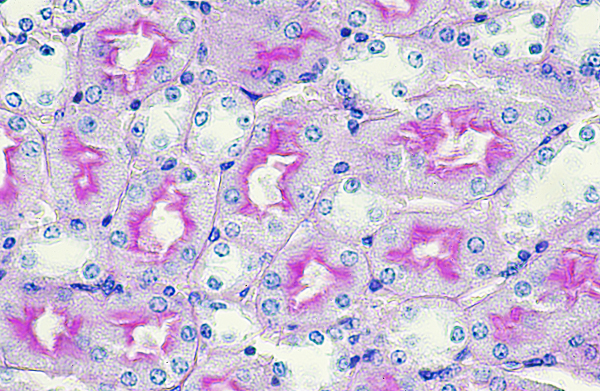
*image above is from a traditionally prepared histological slide*
A few of my older works…
It occurs to me, that I should really highlight a few of my older works from time to time here, specifically the ones that are still available for purchase. So, here are just such a few…
This is “Phoenix Rising.” It was completed in the beginning of 2002. I did this one after first moving to Los Angeles. I had these nifty gold and copper metalic paints to try, and a nice new fan brush. I was watching the coverage of the 9-11 attacks on my little tv, in my little new apartment. I started out playing with flames on this one, but somewhere got swept up in the hopefulness a lot of us were feeling at that moment, plus I’ve always enjoyed the idea of the phoenix. So I wound up making this.

It’s about 24 inches tall and 20 across.
In 2004, I painted this.
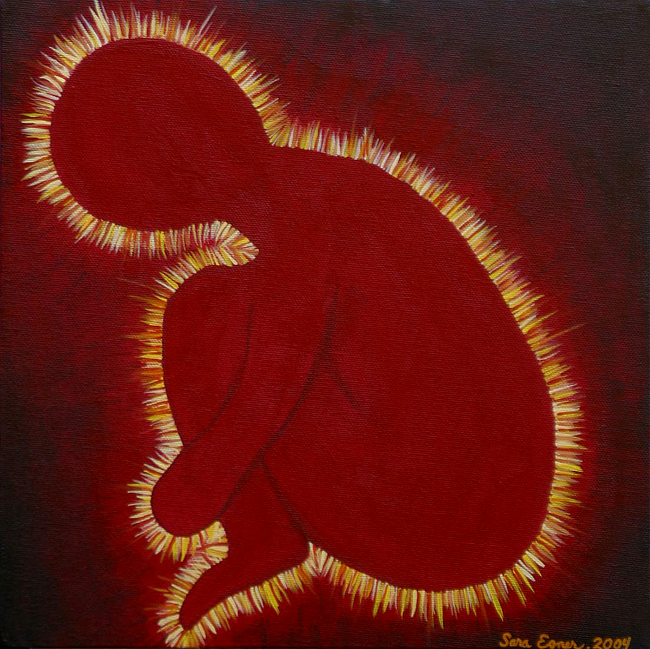
Something about this image just felt right in the making. It’s one of those that people seem to see a lot of different things in, and that’s part of what works about it for me, so it has always been labeled “Untitled.” It’s about one foot by one foot.
This one is from 2007. It’s called “Swirl.” And in some ways I have it to thank for getting me where I am today.

I struggled and struggled with this one, specifically with his hand in the foreground. This painting, and specifically that struggle, is why Ian Coulter started teaching me to sculpt, starting with hands, and that door opening put me in a position to be ready to jump when I would later learn about the field of anaplastology, which is how I got into medical art.
And lastly I’d like to show “The Fall” from 2008, shortly before leaving Los Angeles for Chicago.
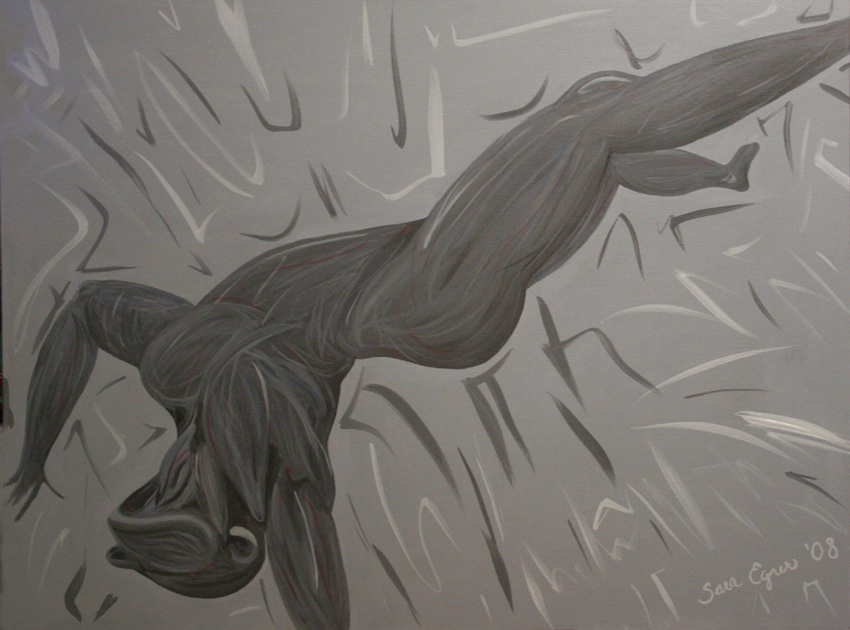
This one remains the largest piece that I have done to date. Measuring 40 inches across by 30 down, this one felt like it took up my whole studio apartment back in LA. I haven’t quite worked back up to that size again, but I would like to someday.
I’ve been working at getting back in to the swing of painting here in the new space, but so far that’s been slow going. It’s been strange doing all of this art for work, but so little on my own. It’ll come though.
A Year Without Clothes
This started out as a post about references, but I guess I got sidetracked into talking about a particular project that a couple of roommates out in California have been up to lately. So I’m just going to tell you about A Year Without Clothes instead. Photographer Keith Allen Phillips, otherwise known as Lucky, and his roommate/amazing model, Sylva, otherwise known as Scar, have committed themselves to a year long photography project. Every day, they put together a photo shoot. Sometimes these shoots are more high concept, sometimes they are simply beautiful images. In one image Sylva is clothed, in the other she is not.

Now, for someone looking for reference as to the human form, you couldn’t ask for a much better collection than this. Especially for those who sculpt, there is great value in getting references that allow you to see both how clothing fits a body, and also what the body looks like beneath the clothes to make them fall or cling in the ways that they do. There is also the added benefit of being able to follow a single model across so many different looks. But I find that I can’t just speak about this project in terms of reference, because the body of work being created here is something fantastic on it’s own right. And it just has so many things going on to appreciate. For one, the fashion is fantastic. You would think that a project called A Year Without Clothes wouldn’t have such a fashion presence, but fashionistas prepare to be impressed and inspired! For another, the creativity behind the individual shoots is pretty fantastic. Some of them are themed. Some of them use props or costume pieces. Some of them are commentary. But really, the entire collection is a work of art unto itself built upon each day’s work within it. There is something that feels very bold and very human about this repeated expression of this one person in clothes, and rocking those clothes I might add, and then simply without them, and rocking that too. You wind up with this sense of fashion that transcends clothing. I guess I appreciate it as art for the same reasons that I appreciate it as reference. It tells that story of a person beneath their clothing. And it celebrates that person beneath. So often we see nudity in art as an expression of vulnerability, but more often than not we see Sylva at her boldest in the nude shot. Something about that recurrence seems celebratory of the human form. And especially when combined with the journal they are keeping as they do these shoots, the whole thing feels celebratory of the very state of being human.

The daily images and journal are posted at ayearwithoutclothes.com
Molecules Molecules Molecules!
This week, I’ve been engrossed in making molecular movie magic! When I was a student at UIC, we learned about the Protein Data Bank, and I thought that was pretty cool. We would bring files into a free program called Chimera, clean them up a bit, and export them as .stl or .obj files, anything we could pull into 3DsMax. I think that with larger files, you would also have to take the intermediate step of going into Mesh Lab to try and reduce your polygon count. From there, you could put any kind of material on them, set up lighting, do anything you wanted to.
I think that this was the first one I ever tried…
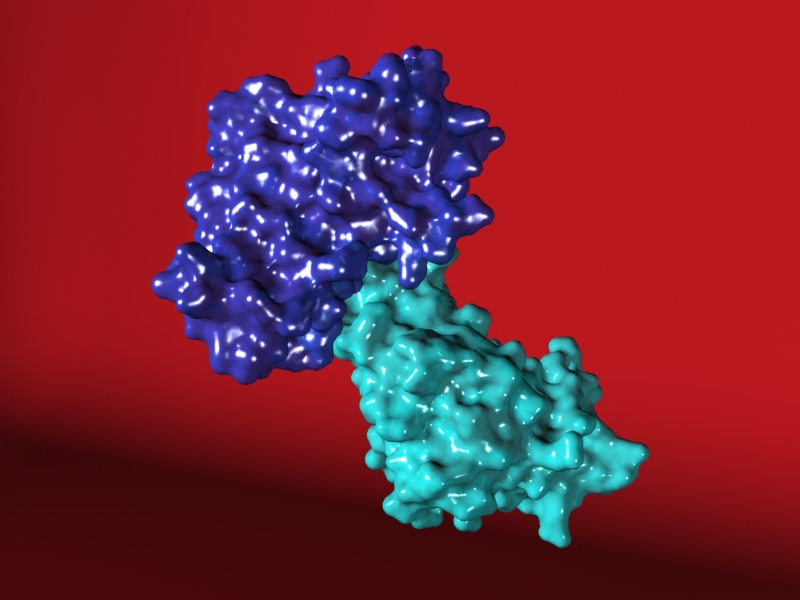
The image itself may not be all that impressive on it’s own right, but I remember being excited because I’d found something related to a good friend’s graduate work. I wish I could remember the name of it now, but I know it was tied to the magnetic bacteria that Cody studied when he was at CalTech. And just the thought of being able to search for and find 3D data related to a friend’s work like that, to be able to bring it into a 3D space and look at it, and then further still, be able to make something of it, and render it into an image that could be shared, well that all seemed pretty exciting.
A year or two later, they came out with Molecular Maya. This took out all the difficulty of working with Chimera, and allowed you to pull data directly from the PDB (Protein Data Bank) into Maya (which is another 3D animation program, much like 3DsMax).
Since coming to work for Sapling Learning, I have been using Cinema 4D (as opposed to either Maya or 3DsMax). And I have a plug-in downloaded called ePMV which is short for Embedded Python Molecule Viewer. It’s pretty awesome. Much like with Molecular Maya, you get to bring files directly in to your 3D scenes, without having to use other software in the interim.
I’m not sure if it didn’t exist before, or if I just didn’t know about it my first times trying to navigate the PDB, but finding PDB 101 was been a great help in being able to find the right proteins when looking for something specific. It’s also been a wealth of information when I’m trying to understand more about a molecule that I’m working with.
But I have to say that what I’m really excited about this week, is the realization that Marvin Sketch can be used to get a .pdb file on any molecule that you can draw. A coworker/chemistry genius showed me the Marvin Sketch Molecule Viewer, and I knew it was awesome when he did, but the more I get my head around all this, the more awesome this tool becomes. You can literally draw out any molecule you know the arrangement for, ask it to clean it up in either 2D or 3D for you, and if you’re looking at the 3D, you can export the file as a .pdb and just like that you have everything you need to bring it in via ePMV and use it for static illustration or animation.
Now this still leaves me limited by the fact that I really don’t have a background in chemistry, and I often don’t know how to draw out the thing that I want (though I am learning a lot of that sort of stuff these days). So how amazing did I feel when just this week I noticed SMILES (Simplified molecular-input line-entry system.) Oh yeah. So there I am, scouring the internet for a clean model of ATP (adenosine triphosphate). And there are literally thousands of references to it within the PDB but it’s always with something. I wanted to find it by itself. And then I’m looking at the Wikipedia page on it. They have 3D models featured. Clearly this data is out there. I should be able to find it. And then I’m looking at the formula for ATP, and it’s C10H16N5O13P3. So I think to myself, that if I were better at drawing out molecules, I could just get it out of Marvin sketch. But sometimes Wikipedia has links to PDB pages, where was that? Well it didn’t have that but it did have a listing where you could show SMILES data
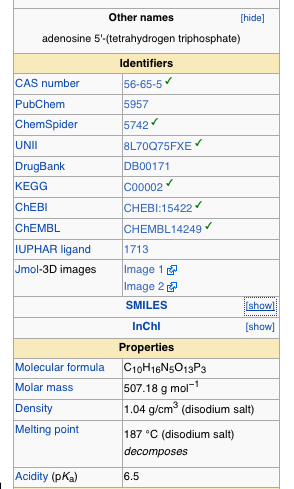 And if you just click the box that says show, next to SMILES, it gives you a code. You copy that code and paste it right into Marvin Sketch Molecule View SMILES loader
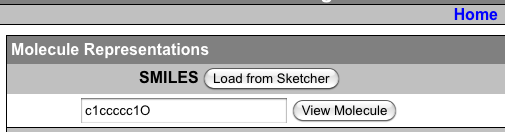
And just like that, you can get any molecule that you have that code for. I did this for ATP, ADP, glucose, and glucose 6 phosphate. They all had a SMILES code, listed right there in Wikipedia. And I was able to save .pdb files right my local computer’s desktop. And when I pulled them all in to Cinema 4D with the ePMV plug-in, I realized that it was easy to see exactly what atoms are coming off of one molecule and added to the other in the process I am working with. And because it was all so accessible like that, we’re going to be able to show people that, really clearly.
I don’t have any of my files from work handy here, but just now I put ATP’s code into the SMILES loader of Marvin Sketch and exported a 3D PDB file. I opened the file using Chimera and in less than a minute had this.
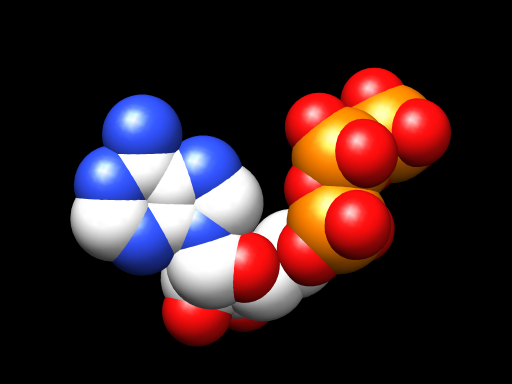
And if I were doing this in a 3D animation program, I could take things further still and make it pretty, make it move. Or I could grab that last bundle of spheres there, the last yellow (phosphorous) and the reds (oxygen atoms) clinging to it, and pop that right off to show you the difference between ATP and ADP, and what exactly that means when people talk about that happening.
I think that’s really friggin cool!
Well, I suppose I should stipulate that we’re *almost* seeing exactly how that works. I just learned today that there’s hydrogen in there too, but chemists seem to have this game of hide-the-hydrogen that they like to play on the rest of us. They claim it’s clearer that way. They’re probably right, but I’m not 100% sold yet. Still, except for the invisible hydrogen atoms, this is what ATP looks like. This is it’s shape. And all those reactions in the body where ATP gets converted to ADP are just this little guy getting a little bit shorter when that last phosphate group teams up somewhere else.
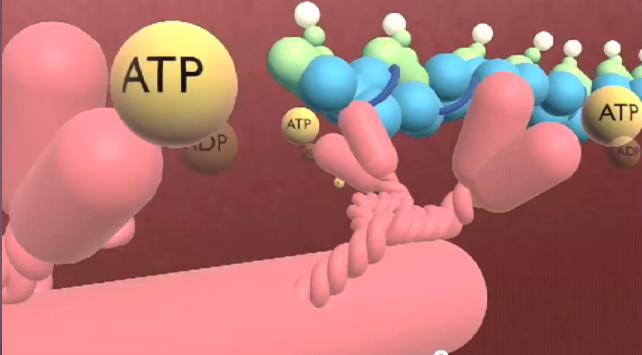
When I made my sliding filament animation, I remember having no idea what ATP actually looked like. I remember talking to other people about it, and none of the people I spoke to knew either. I wound up representing it with big yellow spheres in the animation. And that worked for the piece that it was, and was actually very clear in terms of what needed to be shown there. But I just love that this week, while trying to figure something out about ATP I wound up with not only a better picture of it, but my own model to play with and animate.
I suppose that lately it’s just been molecules molecules molecules for me. I never thought I would get this into the micro world, but I have to say, I think it was time. And with all this technology, all these programs making it easier than ever to really see and get a handle on what everything really is, well, I can’t think of a better time to be learning this stuff.
Bespoke
A couple years ago, a friend told me about Bespoke. She pointed them out to me because their goals so sounded like my own with regard to patient care. Last week, I was listening to TED talks online and came across one called “Scott Summit: Beautiful artificial limbs.” Sure enough, I come to realize that Scott Summit is behind Bespoke, a company that wasn’t ready to hire an anaplastologist when I contacted them, but I still have to say a company that seems to get it.
http://www.ted.com/talks/scott_summit_beautiful_artificial_limbs.html
If anything, I would have to say that the only thing these guys are missing is the option of a prosthesis which mimics the part that was lost accurately. For some, that’s the best solution. But that aside, I think that they are doing great work. They’re doing great work that I would like to see come in to the realm of prostheses that are made to be more accurate, or just prosthetics in general. So often in medical care of any kind, it seems to be the individual that is lost. These guys aren’t making that mistake. How refreshing!
Anatomical Nesting Dolls
So yeah, bumming through Google Images on a lazy Sunday is just stumbling me in to all sorts of fun things. Jason Levesque has made anatomical nesting dolls! Neat!

A Fun Piece by Andrea Manzati
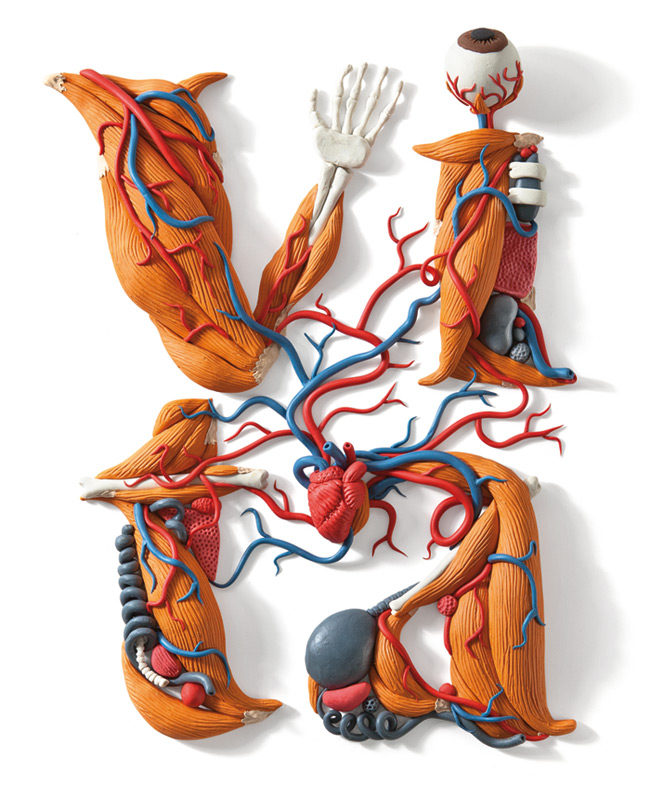
Ooh, take a look at this! Italian illustrator/designer, Andrea Manzati, makes a little anatomy in plasticine. Fun!