Archive for January, 2011
Roger Ebert’s Blog
So, I was reading an article about 3D cinema and thought I would post it here. It’s an argument against the survivability of 3D as a medium as put forth by Walter Murch, author of In The Blink of an Eye, and editor of such films as The Unbearable Lightness of Being, Apocalypse Now, and The Godfather. I saw him speak once, when I was an undergrad in film school back in the 90s. He had just finished working on Cold Mountain and he was fascinating to listen to. Truly, he is one of the Hollywood greats, known both for his editing, but also specific attention to sound design.
The article is here.
http://blogs.suntimes.com/ebert/2011/01/post_4.html
Then, as I was reading, I realized that this was Roger Ebert’s blog. We heard last week that Roger Ebert had written something about the prosthetic chin he recently had made, and specifically mentions UIC’s very own Dr. David Reisberg. It’s a really nice little article, and cool to see such a story written from the patient’s perspective.
http://blogs.suntimes.com/ebert/2011/01/after_surgery_i_studiously_avo.html
So thank you Roger Ebert, for the excellent blog. And I guess this post can be tagged with both 3D and anaplastology!
Creating an Implant-Retained Auricular Prosthesis
Doing a little organizing of images over here tonight. I’ve been in full on shutterbug mode around the clinic this month, and now it’s time to go through all those images for the presentations we are giving on Monday. Once again, it’s a Power Point format, and once again I find myself wavering between a lot of text on the screen and being more image based.
The presentations we are giving are all with regard to a bench exercise we recently did wherein we created an auricular prosthesis with acrylic substructure and clips for implant retention.
For this one we started with an assigned treatment side impression from a patient, and a cast ear from a patient. The cast ear was scanned with the laser scanner, and then milled into hard blue wax using a CNC milling, or rapid prototyping, process. A vacuuform impression was then made from the blue wax model and we all individually poured hot wax into the form to create a working wax model of the shape for ourselves.
We also each poured casts reflecting the treatment side of a patient, and used these as bases on which to sculpt. We were given clips, like those that a patient would use to attach a prosthesis if they had implants, and these were positioned along the stone bar replica of the treatment side casts. And we were asked to create a light cure acrylic substructure to join these clips and provide stability to the prosthesis on the whole. The working soft wax from the vacuuform impression was positioned on to the stone cast over the substructures that we created and fit individually to that positioning.
The sculpture was then perfected using a variety of sculpting tools, made smooth, and then lightly textured.
From this sculpture a mold was made. First we cut keys into the stone cast itself. Then the outer edges around the cast were boxed up (given walls.) Then with a separator covering the stone (I believe in my case I used liquid foil), we poured new stone to fill in the space behind the back of the ear. We only poured to the helical rim (outer edge of the ear) to prevent undercuts in our mold later. Once this stone had fully set, I was able to cut keys into that layer, and cover the new stone with liquid foil as a separator. I then mixed and poured new stone to create the top of my mold.
Once all aspects of the mold were set, it was time to melt the wax sculpture inside. It’s always a little bit nerve wracking doing this, because you’re melting away the part you worked on the longest. But you need to remove the wax completely and even steam or boil out any wax residue before you can go on to the next step.
With a clean mold, and with some kind of separator in place (I believe this time I used Colombia Model Gloss), and a properly prepped acrylic substructure (the substructures must first be cleaned with acetone, and then coated with a primer and let to sit for half an hour) you can pack your mold. I chose to match my colors to a photo I found on the internet. I started by painting in my red glaze, as is customary. I then moved on to plant a couple freckles, and place some vasculature using colored yarn. I painted a tan glaze in along the areas of the ear most kissed by the sun, and a cartilage glaze in the areas where the cartilage is right against the skin and lightens the color, and a shadow glaze into the crevices and places that often appear darker in an ear. Finally I poured my base silicone into the rest of the ear and closed the mold with the acrylic substructure attached to the bar.
In my case, I allowed my silicone to sit and bench cure over the next couple days and didn’t actually put it in the oven until later. It is my understanding that they acrylic will not bind with the silicone without some time in the oven, so I didn’t want to skip that step later, even though the silicone had most likely fully cured by then itself.
When I opened the mold, there was a lot of run off, or flashing, to trim off of the silicone everywhere the mold’s pieces came together. I also cut a whole where the ear would naturally open to provide hearing. Most patients can still hear at least somewhat despite not having the external features of an ear, so generally an auricular prosthesis provides an opening to allow sound to travel.
I think the trickiest part in trimming was trying to get around the clips in the back. I think this will become easier as I get better with razor knives. I certainly hope so anyways.
I did some last minute extrinsic coloring using the A-564 silicone. I used the technique where you sprinkle powdered sugar over the silicone while it is still wet and allow it to cure that way only to wash the sugar off later and keep the texture it’s left behind. This prevents the prosthesis from being overly shiny by breaking up the surface subtly.
All in all, I think that the ear looks pretty good. I would post a picture, but I’m not sure we can given that the original shape did come from a patient, even if the coloring didn’t. So you’ll just have to believe me when I tell you of its finesse 🙂
Anyways, that’s the process more or less.
Malaria Caught on Tape!
This just in, breaking footage of malaria caught in the act of breaking into and infecting a red blood cell!
This footage comes to us from the Institute of Medical Research out of Melbourne Australia. The invading parasite is called Plasmodium, and it has been known to kill nearly 1 million people worldwide each year.
You can read more about the video here at New Scientist.
http://www.newscientist.com/blogs/nstv/2011/01/malaria-caught-breaking-and-entering-red-blood-cell.html
Teaching Horse Anatomy
So, I’ve seen a lot of photographs where the underlying anatomy gets drawn in over the surface anatomy. I’m actually pretty fond of that style of portraying how anatomy fits inside. But yesterday I stumbled onto this picture.
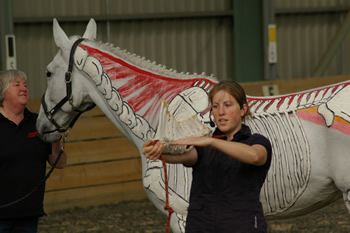
It would seem that instructor and sports therapist, Gillian Higgins has perfected the art of painting the underlying anatomy straight on to the surface, and does so repeatedly with her horse to teach horse owners about what’s inside.
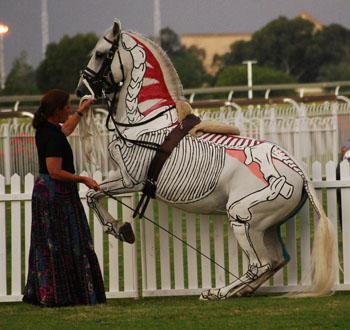
This Youtube video gives a nice quick summary of her endeavors.
You’ve got to admit, that’s pretty cool!
Rapid Prototyping
One of the things that has been particularly emphasized in my anaplastology training is the usefulness of rapid prototyping. Wikipedia defines rapid prototyping as “the automatic construction of physical objects using additive manufacturing technology.” My own understanding has always been that it includes both additive and subtractive manufacturing. Either way, you get to essentially print out 3D objects from a file, and that’s pretty cool.
For clinical usage, this is particularly helpful alongside a laser scanner. If you have both, you can scan in casts made from impressions taken from patients, alter them digitally, and then print out the altered models for use in your own physical creation. The catch is that technology is expensive. The party line has traditionally been that rapid prototyping in particular is expensive. But the touch of awesome is that those prices seem to be coming down.
At the clinic we have a CNC milling machine. It’s a big deal. Maybe just a year ago the clinic was featured in the news and that very machine was photographed to represent our cutting edge technology. And it is useful in what we do.
Just a few weeks ago I was visiting Texas, and an old friend mentioned a 3D printing company where you could send your own files for manufacturing, Shapeways.com. They charge by the square centimeter. And it’s affordable enough for my friends to be using it to make game pieces. That’s clearly not as practical as having your own machine, but it does show a movement in accessibility.
Then just last week someone was posting an article from Cornell University on the AMI list about how 3D printing may soon be a household capability. I have to think that whether or not that is the case, clinically at least, this technology is about to be very accessible. I’m glad that we are learning to use it now.
Of course all that being said, I haven’t heard a word about laser scanners coming down in price yet. But knock on wood, it’s bound to happen too. And I, for one, know a thing or two about digital manipulation. All of my animation software is directly applicable to just such work.
This is something that I can do.
Back in Chicago Again
Well I am officially back in Chicago after winter travels, and yes, winter is right where I left it here. On Monday I’ll be starting back up with anaplastology in UIC’s Maxillofacial Prosthetics Clinic again. And then mid semester, around the beginning of March I’ll be heading down to Texas to intern with The Medical Art Prosthetics Clinic in Dallas. If I play my cards right, this looks to be my last semester with UIC. First and foremost on the list with that comes finishing up my project research in time to present this semester. That’s the patient education piece on those craniofacial surgeries. It’ll be tricky, with all the intern hours and moving around the states I’ll be doing, but it is possible. I’m also looking at taking on a bit of video work, digitizing some tapes of interviews with some of the victims of thalidomide poisoning from those cases back in the 60s. I’m also still selling prints from that painting and keeping the Cafe Press store. I’d actually really like to find the time to paint some more here, but it’s difficult getting to do everything. For right now, I’m just trying to get my home in order for the upcoming week. It’s been a great vacation, and now I guess it’s time to get back to work.