Archive for September, 2013
Showing Exponential Growth in Bacteria
So I got an interesting request from the math department at Sapling Learning about a week ago. We wanted to show the concept of exponential growth, using bacteria as the example. So one bacterium divides into two and they each divide into two and so on. We decided to take this through six generations landing us with 64 bacteria on screen by the end of it.
So the catch was, how to move 64 bacteria around as one, and then as two with an equal number of divisions nested inside and then as 4, each with an equal number of divisions inside, and then as 8 and so on. So I got a little complicated with my object hierarchy for this one.
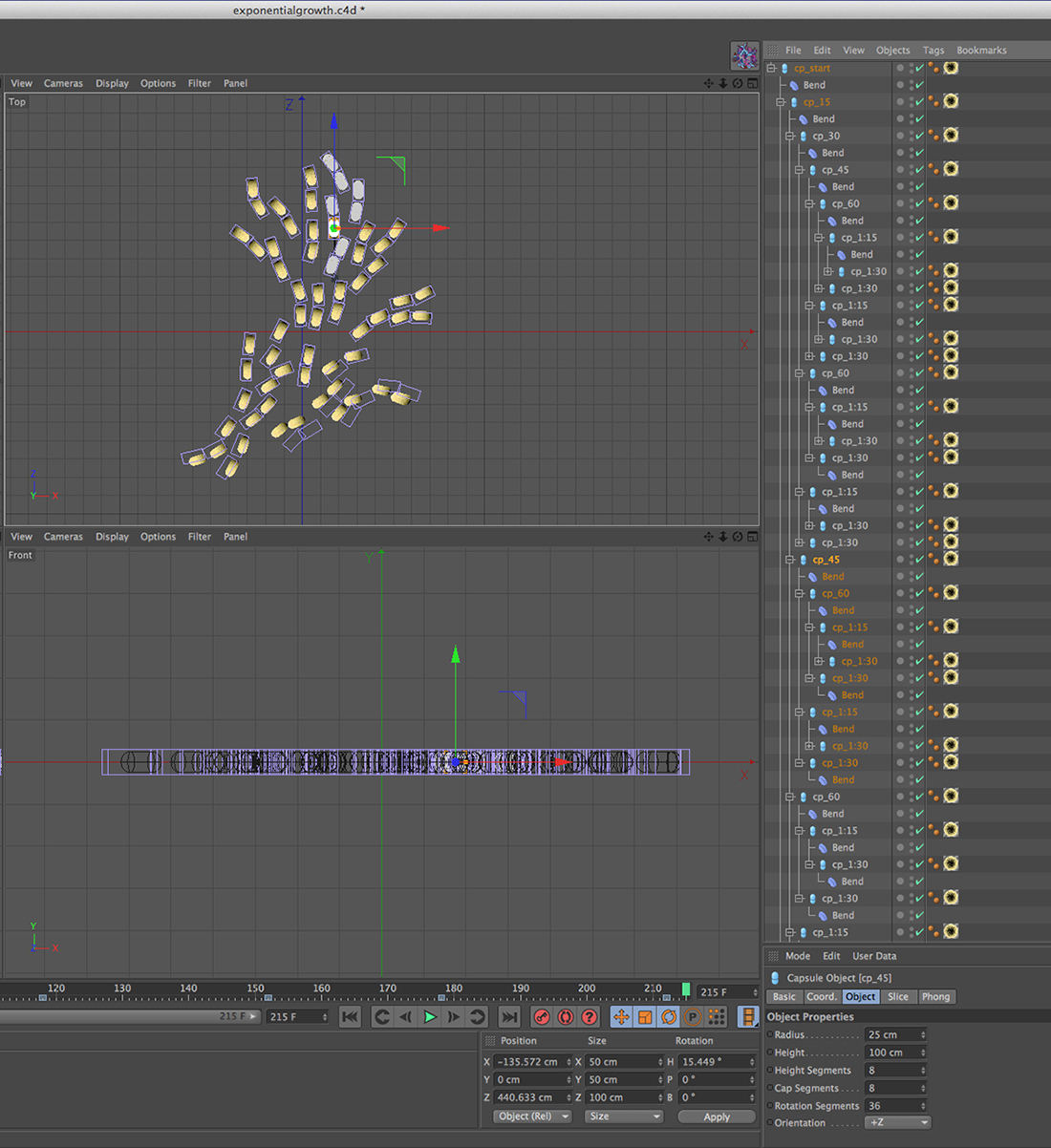
So I had one called cp_start, short for clostridium perfringens (a bacterium capable of reproducing at the 15 minute generation cycle that we wanted for the example) with a bend object on it. And then nested within that one was a duplicate called cp_15, another called cp_30, cp_45, cp_60, cp_115, and cp130, to represent the ones that would branch divide off at the 15 minute, 30 minute, 45 minute, hour, hour 15, and hour thirty points from that one, all with their own bend objects. Then within each of those I had further duplicates that would still occur from each of those. Within cp_45 there was cp_60, cp_115, and cp_130, but cp_60 would only have cp_115 and cp_130. And then so on with each bacterium.
In the end it worked out, and the extra arranging effort was well worth it as the sprawl pattern of bacteria had to be adjusted after the first time. My first attempt had them all more compactly arranged, but one of our biology experts explained that bacteria could only continue a regular exponential growth cycle if they were able to get to more food. If I hadn’t had them nested like this, it would have been incredibly hard to go back and make them disperse further.
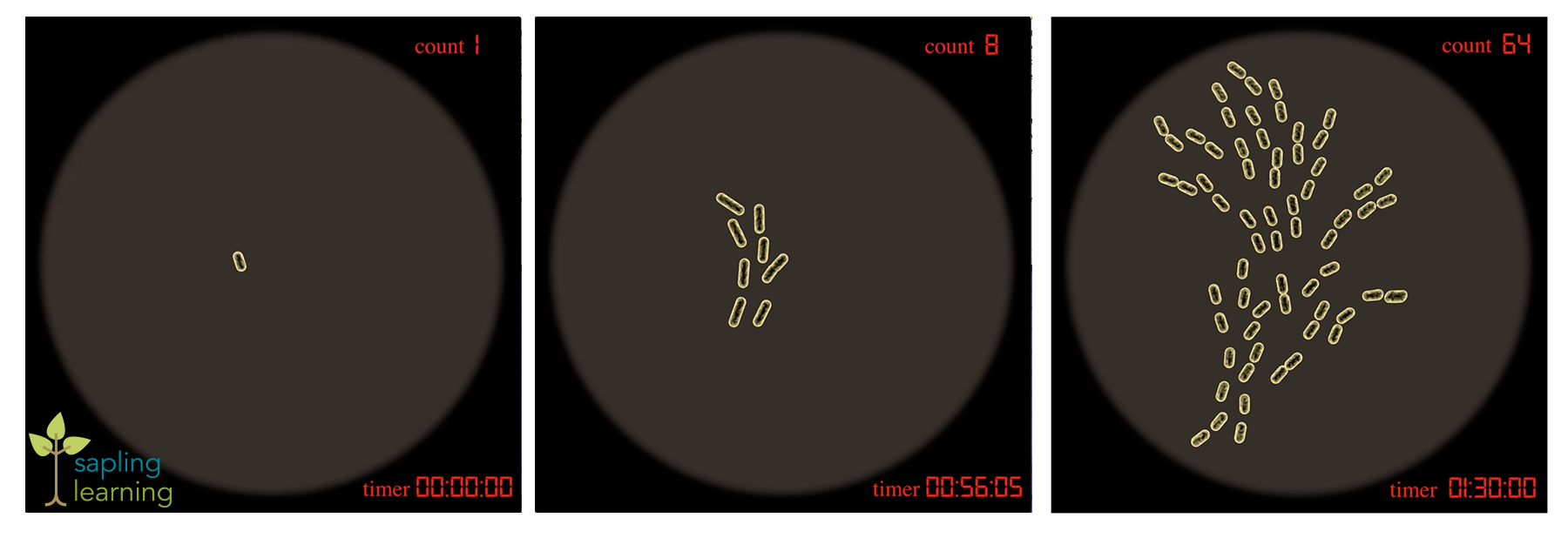
I added the timer and count in After Effects. The whole thing plays at a sped up pace, showing one minute per second of animation. And I think it looks good. I hope that we get to use it for biology content someday as well as for the math example now.
Playing With Paint Again
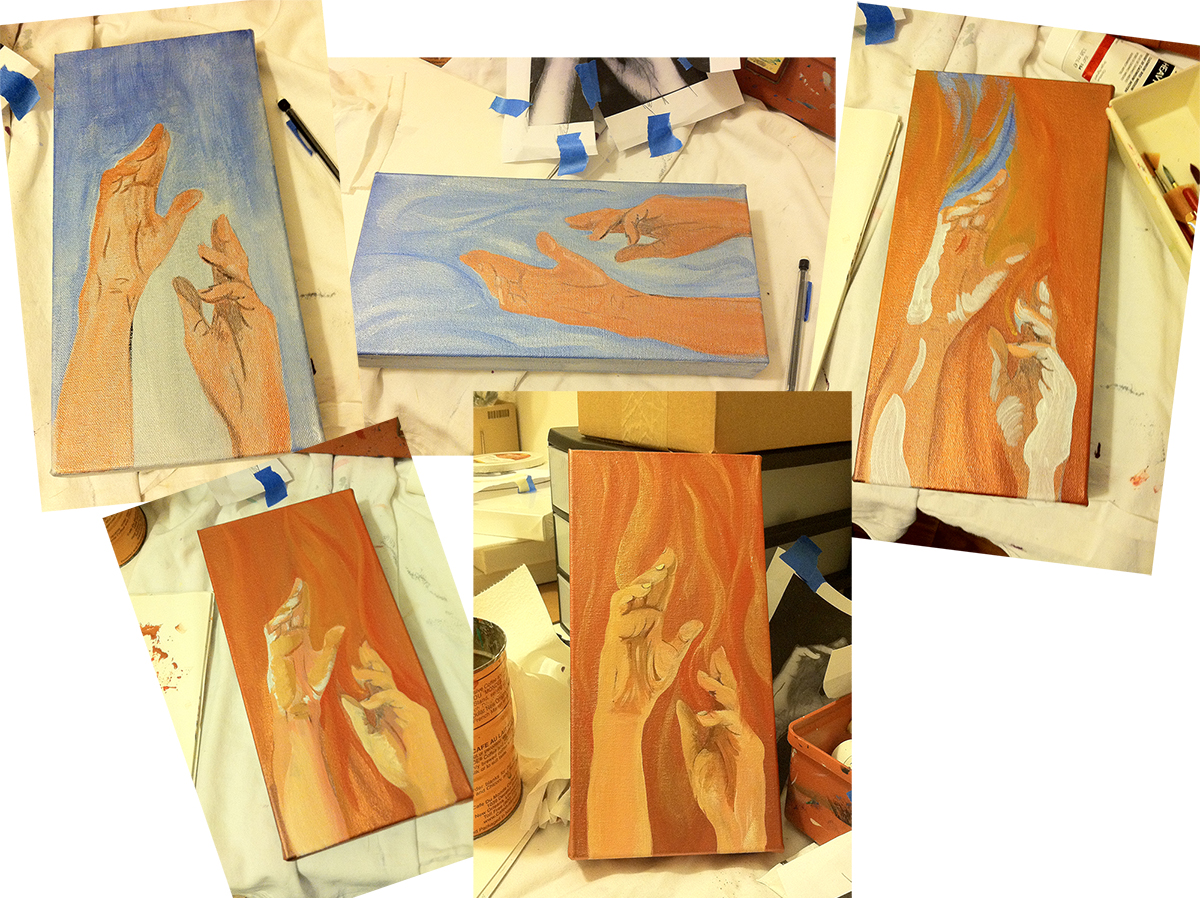
I am finally starting to settle into the new studio space at my new place. Been playing around a little bit lately with hands. Nothing is finished yet, but I thought I’d go ahead and share the work in progress so far. I think it’s coming along.
New York Event – Morbid Anatomy
This October, the New York Academy of Medicine is offering a festival on Medical History and Arts
More information can be found here…
http://morbidanatomy.blogspot.co.uk/2013/09/new-york-academy-of-medicine-festival.html
Many of you who read here are also familiar with Morbid Anatomy. They along with Lawrence Weschler are co-curating this event. Sounds worth checking out!
3D from 2D
My plan to get a full figure out of 123d Catch has so far fallen flat. My efforts seem to alternate between mostly outright failures sprinkled with unusable results.

I think that the best capture we got was in the office lunch room, using the iPad. As you can see, we still got a lot of scatter from the surrounding room. And it’s harder to see in this image, but you can tell that there was a tiny bit of movement that resulted in a little bit of distortion in my model, Ernest’s, face.
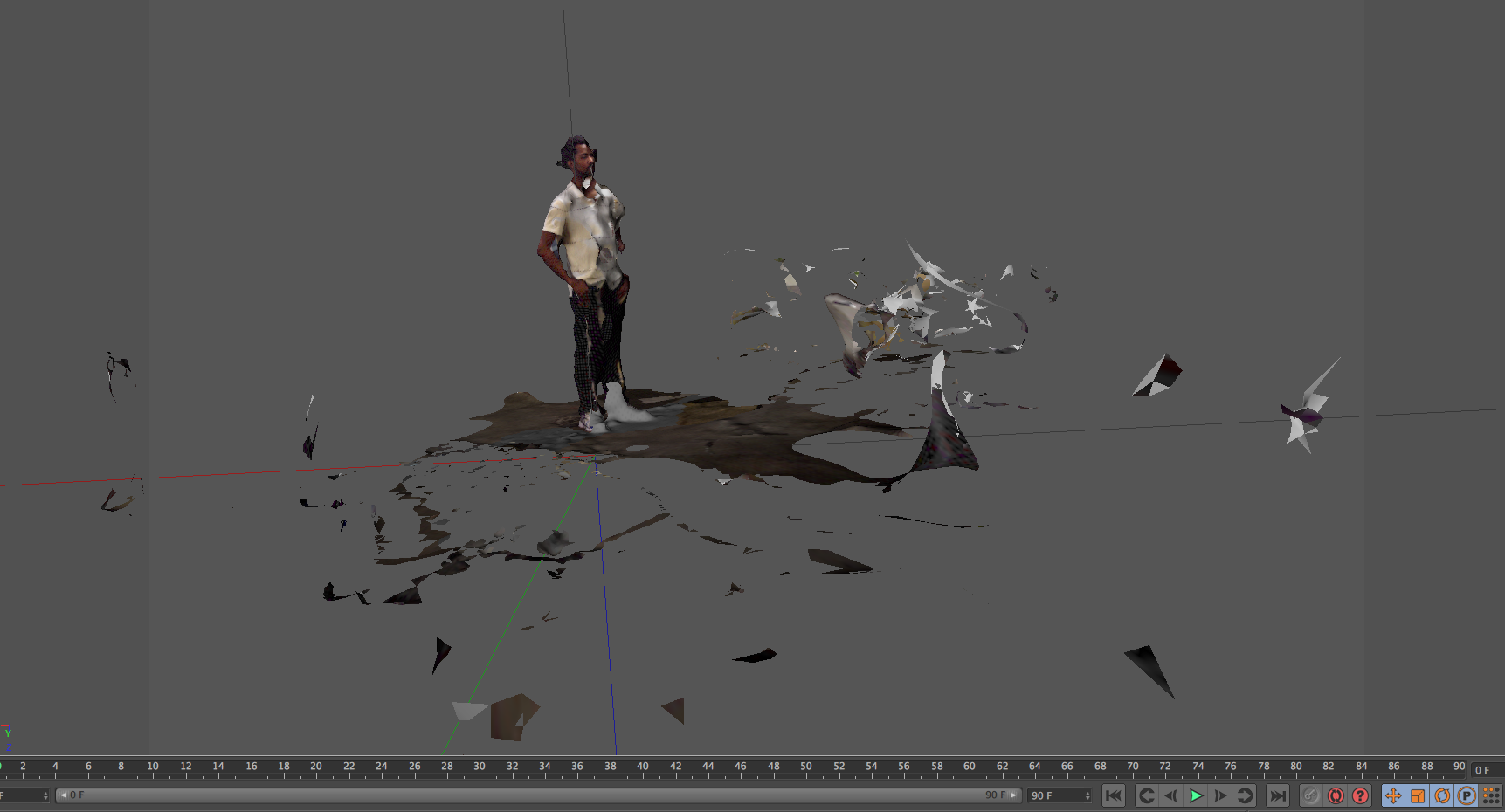
I think that the lunch room capture did better than the office capture near a window or the outside/ sidewalk capture because the light was flatter. I’ve noticed that the program seems to have trouble with both shadows and also bright highlights. Which is why we decided to try taking photos one more time at my place, with my Cannon 20D SLR camera, late in the day so that the light wouldn’t be more even. The below images are some of what was shot, to give you an idea how we were going about this. I went all around him, then got up on a step ladder and got shots all around from above. I made certain to get the top of his head, since we’d had trouble with that in a previous attempt. I got down low and shot upward to avoid any blank spots under the chin or hands. I took closer shots of the hands and legs and feet to prevent a previous effect I’d seen where the legs and floor between them had been treated as a continuous object.
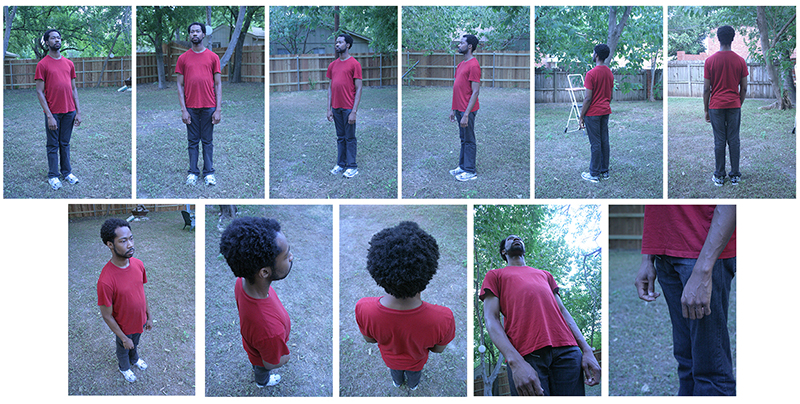
I think that we had the right idea here, but I’ve since learned that the software relies a lot more on background overlap than I’d imagined. So while I was sure to get overlap in my shots of Ernest, I didn’t think about making sure that trees were identifiable in the background from one shot to the next, or that I include the kind of overlap on the house that would help the software align shots.
My error became clearer when I tried to crop all of my images down to just Ernest, thinking that it would focus the software on the intended subject, but my results only became worse for doing so, and as I read more about it found advice to the contrary. If I were to do this again, I would put clear identifying objects on the ground near my model to help the software key. And I certainly wouldn’t have let the ladder ever be in different locations for different shots in the background.
I would like to try this again sometime with better attention paid to my lens as well. While I wasn’t using a telephoto lens, I did have a moderate zoom lens on and I’m pretty sure I must have adjusted that between shots a little. I also wonder about how the depth of field affected my results. Sometimes there’s only so much you can do, especially shooting a tall lean figure like Ernest. But I’m sure that as broad a depth of field as possible would be better.
Ideally, I’d have something like 60 cameras set up all around to cover all angles and on different colored tripods to help the software key each shot as it makes it’s shape, all firing at exactly the same time. I could capture action shots with a set up like that, and skip the race against the setting sun entirely. But I still think there’s possibility to get somewhere with what I do have.
Anyway, I had to move on to another method of doing things for my work project, but my interest in figuring out this technology remains.